55 Continuing Education Insights - 170+ Statistics for 2026
55 actionable CE insights for 2026 distilled from 170+ statistics across six industry studies. Key findings: 97% of employers now use skills-based hiring, credit-bearing micro-credentials drive 2x engagement, and 39% of workforce skills will transform by 2030. Includes 2026 actionables for associations and enterprises.
The continuing education (CE) landscape has undoubtedly undergone a fundamental transformation in recent years. From the rapid adoption of micro-credentials to the integration of generative AI training, professional development programs (PDPs) now compete in an environment where learners expect stackable, credit-bearing pathwaysand employers demand verifiable skills.
For CE leaders preparing for 2026, this report provides a strategic foundation based on the most current industry research.
The insights that follow are drawn from research published in 2025 by the University Professional and Continuing Education Association (UPCEA), Coursera, the World Economic Forum (WEF), the Accreditation Council for Continuing Medical Education (ACCME), Research and Markets, and the Journal of CME. Together, they reveal both challenges and opportunities for associations and organizations leading CE in 2026.
About This Report
This report is designed to serve as a strategic roadmap for CE leaders, associations, and enterprises preparing for 2026. The goal is to distill the fundamental shifts occurring in continuing education into clear, actionable intelligence.
Methodology
The 55 insights presented here synthesize more than 170 distinct statistics drawn from six major industry studies published in 2025. Each insight translates raw data into strategic guidance, with implications tailored for associations and enterprises.
Structure
The report organizes insights into six themes with direct implications for program design, technology investment, and labor market alignment:
Participation and Enrollment: Shifting enrollment patterns and the rise of new credential formats.
Licensing, Compliance, and Workforce Development: Evolving expectations for measurable outcomes.
Credentialing and Microcredentials: The shift toward stackable, credit-bearing, and GenAI-aligned credentials.
Technology, Automation, and Tracking: How AI is reshaping skill demand and operations.
Staffing and Operations: The gap between strategic expectations and available resources.
Labor Market and Employer Alignment: The acceleration of skills-based hiring.
Together, these insights reveal that success in 2026 hinges on embracing modular learning, skills-first hiring, GenAI readiness, andoutcomes-based education.
Let’s dive in.
Participation and Enrollment
CE programs are serving a broader and more dynamic learner base than ever before. Traditional enrollment patterns are evolving as professionals seek flexibility, career relevance, and credentialed learning pathways that fit their schedules and goals.
Understanding how participation is evolving helps CE leaders design programs that reflect today’s learner expectations and tomorrow’s workforce realities.
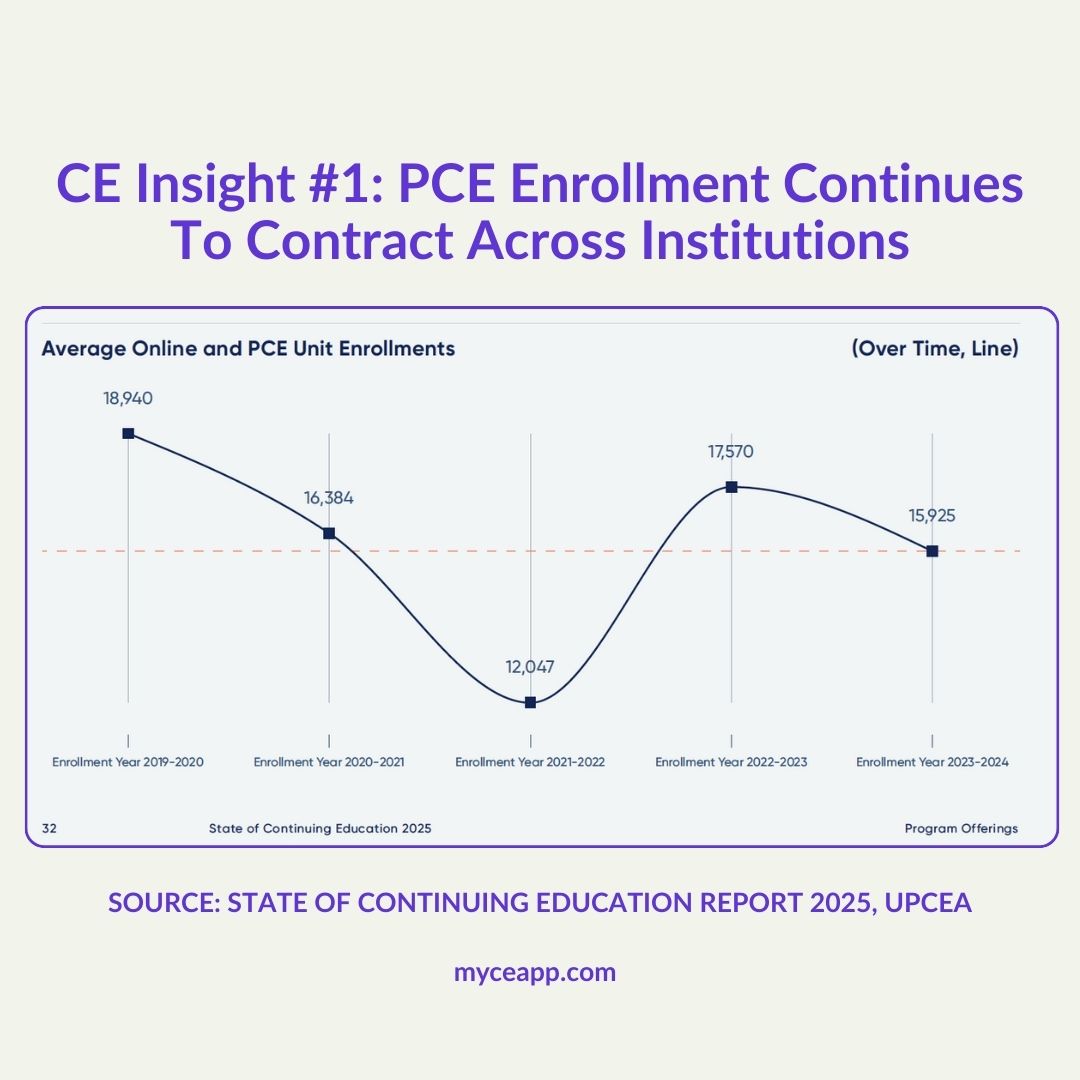
CE Insight #1: PCE Enrollment Continues To Contract Across Institutions
Online and professional continuing-education (PCE) units averaged 15,925 enrollments in 2023–2024 (median: 5,500). Twenty percent of institutions reported fewer than 2,000 enrollments, 21 percent reported more than 10,000, and 34 percent reported no enrollment data. (Source: State of Continuing Education Report 2025, UPCEA)¹
Implications for Associations and Enterprises: Declining and uneven enrollment patterns highlight the need for diversified program formats, stronger data-collection practices, and more refined audience segmentation to better track, understand, and respond to learner demand.
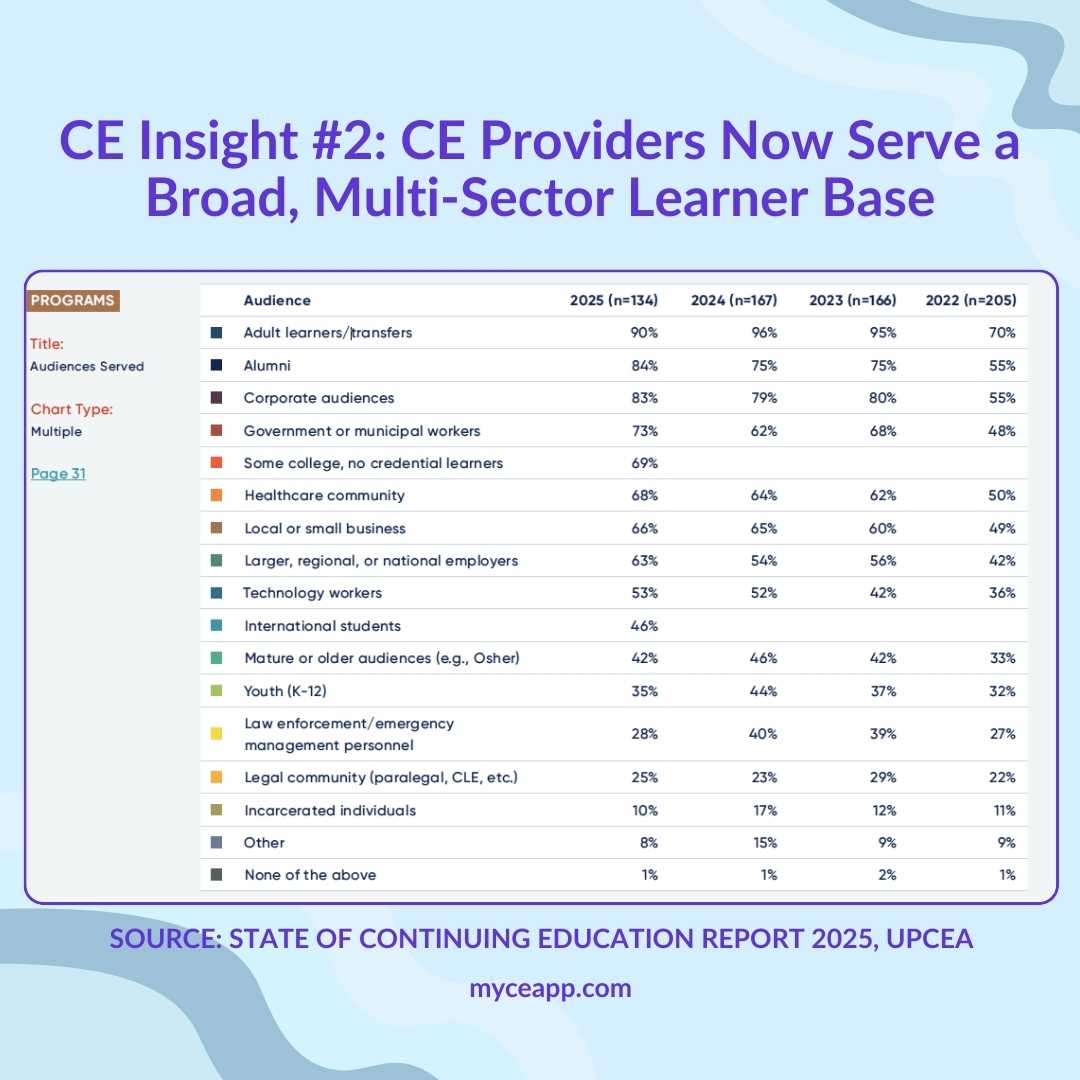
CE Insight #2: CE Providers Now Serve a Broad, Multi-Sector Learner Base
PCE units serve a wide spectrum of learners: 90% serve adult learners, 84% serve alumni, 83%serve corporate audiences, and 73% serve government or municipal workers. (Source: State of Continuing Education Report 2025, UPCEA)¹
Implications for Associations and Enterprises: The expansion of CE audiences underscores the importance of building offeringsforalumni, corporate teams, andgovernment professionals, supported by tailored engagement strategies and employer or agency partnerships.
CE Insight #3: Credit-Bearing Micro-Credentials Significantly Increase Engagement and Enrollment
Students were 2x more likely to remain engaged (40% to 89%) and 2.4x more likely to enroll (36% to 88%) when offered credit-bearing micro-credentials. Additionally, 94% of students want micro-credentials to count toward their degree, and 41% of credential holders have earned at least one credit-bearing credential. (Source: Micro-Credentials Impact Report 2025, Coursera)²
Implications for Associations and Enterprises: Integrating credit-bearing or stackable micro-credentials into learning pathways can drive stronger engagement, retention, and repeat participation across both member-based and workforce learning environments.
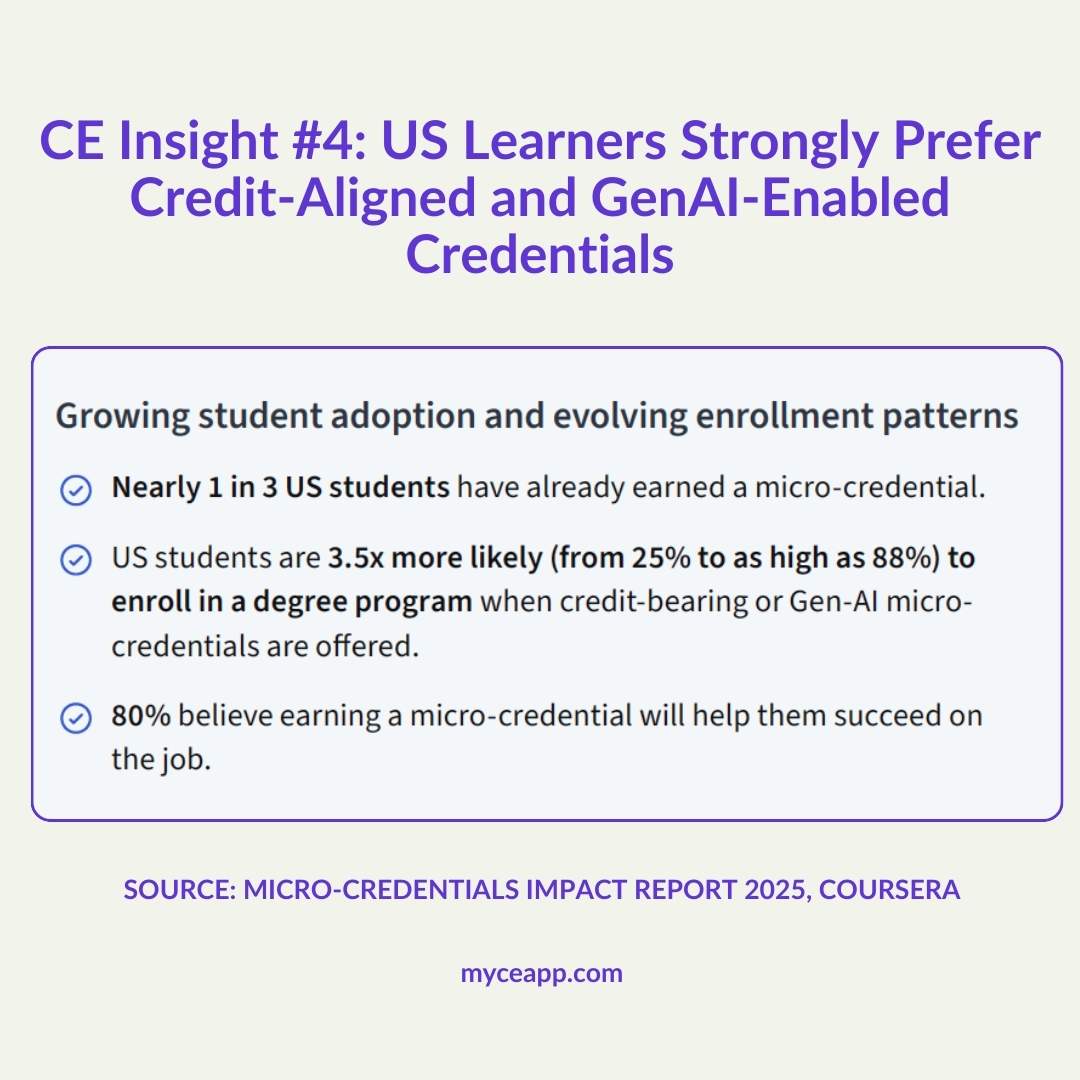
CE Insight #4: US Learners Strongly Prefer Credit-Aligned and GenAI-Enabled Credentials
Nearly one in three U.S. students has earned a micro-credential. They are 3.5x more likely (25% to 88%) to enroll in programs offering credit-bearing or GenAI-related micro-credentials. Additionally, 98% want these credentials to count for academic credit, and 80% believe earning one improves job success. (Source: Micro-Credentials Impact Report 2025, Coursera)²
Implications for Associations and Enterprises: Rising learner expectations for credit alignment, career relevance, and GenAI competencies indicate that CE providers should prioritize credentials that deliver clear academic or workforce outcomes.
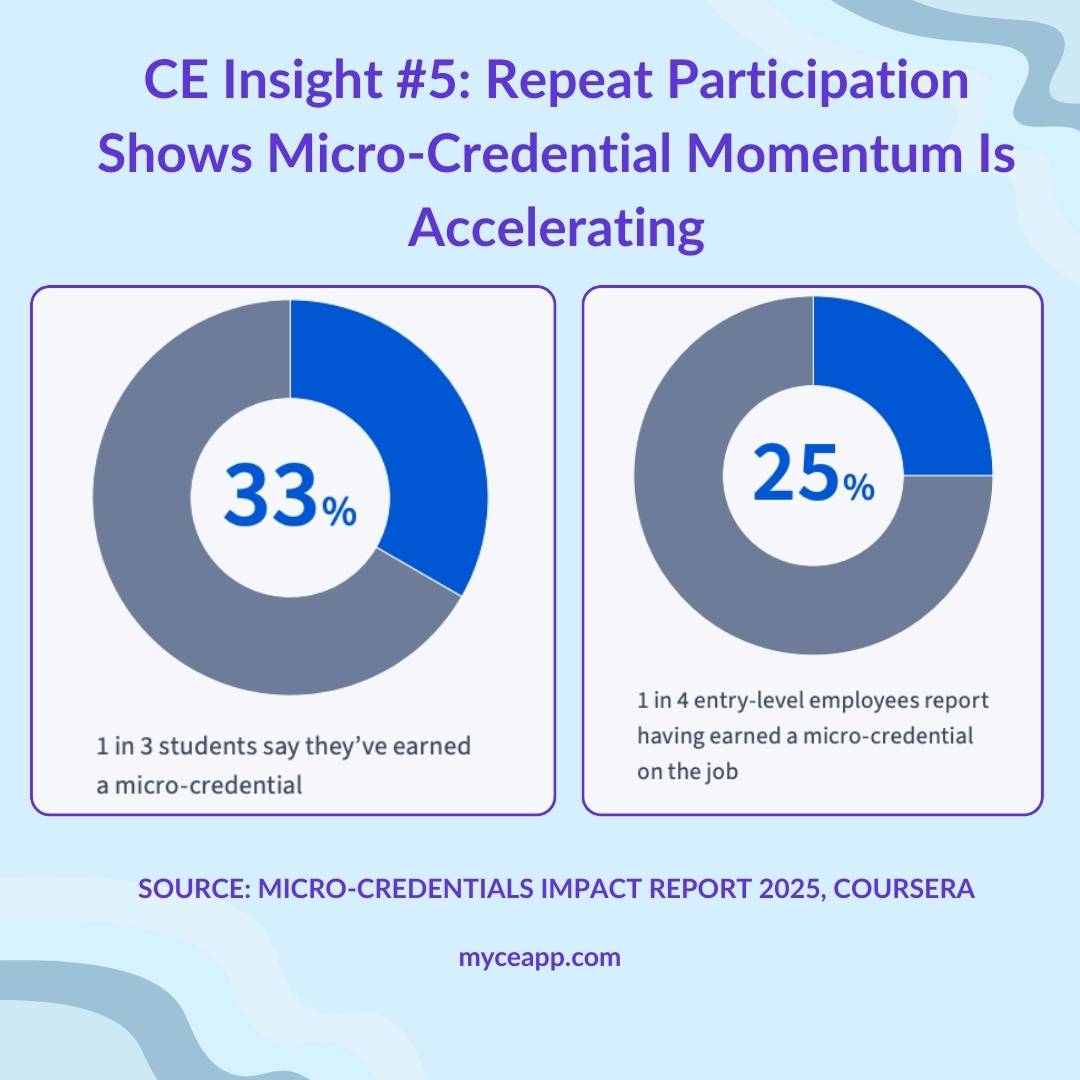
CE Insight #5: Repeat Participation Shows Micro-Credential Momentum Is Accelerating
Among learners who have earned a micro-credential, two-thirds of students and three-quarters of entry-level employees go on to earn additional ones. Overall, one in three students reports earning a micro-credential, and one in four entry-level employees has earned one on the job. (Source: Micro-Credentials Impact Report 2025, Coursera)²
Implications for Associations and Enterprises: High repeat participation demonstrates the value of multi-tiered credential pathways, which can deepen engagement, strengthen workforce mobility, and increase long-term learning lifecycle value.
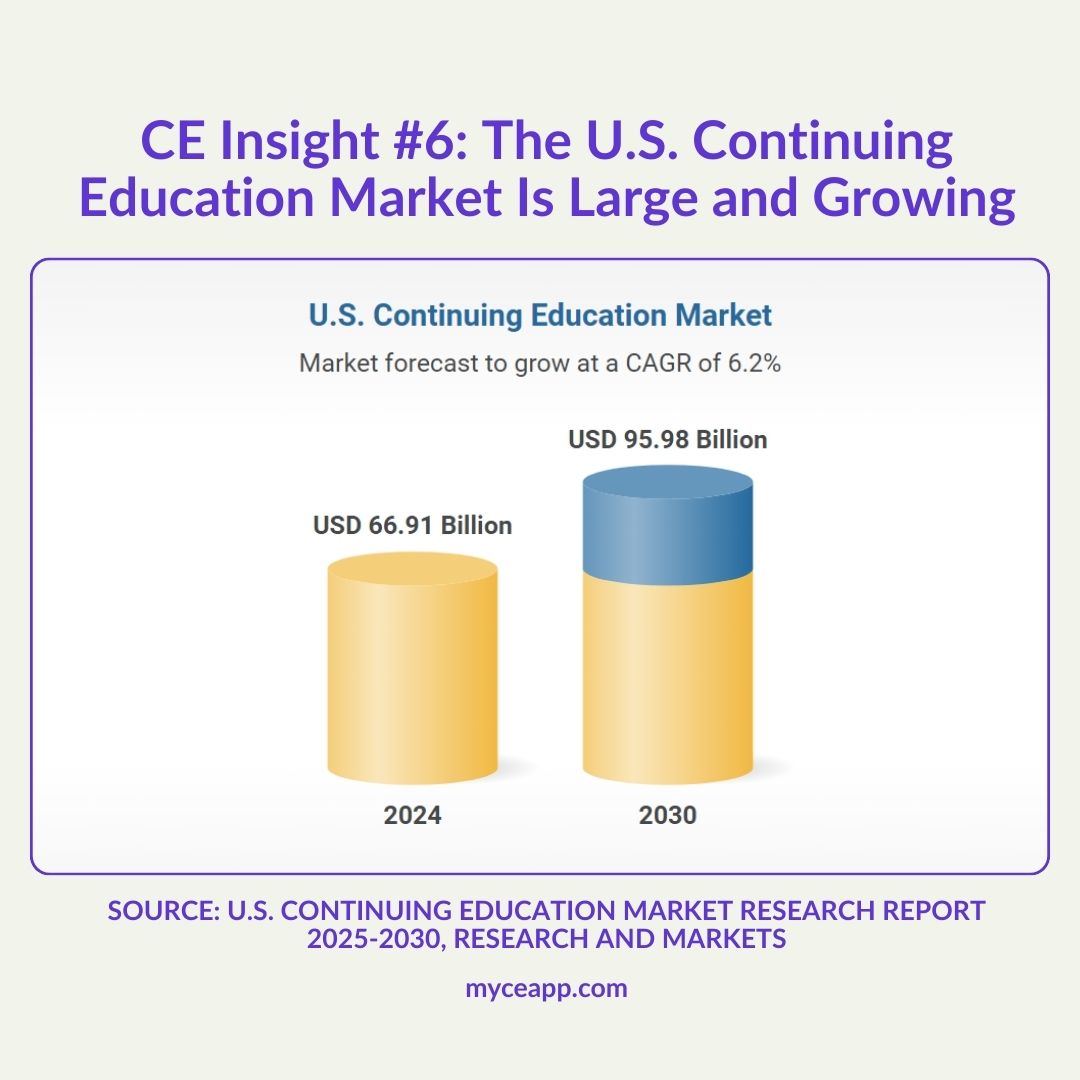
CE Insight #6: The U.S. Continuing Education Market Is Large and Growing
The U.S. continuing-education (CE) market was valued at $66.91 billion in 2024 and is projected to reach $95.98 billion by 2030, reflecting a 6.2% CAGR. (Source: U.S. Continuing Education Market Research Report 2025-2030, Research and Markets)3
Implications for Associations and Enterprises: The expanding CE market presents opportunities for organizations that invest in high-demand credentials, scalable learning formats, and modern education infrastructure to capture growing learner segments.
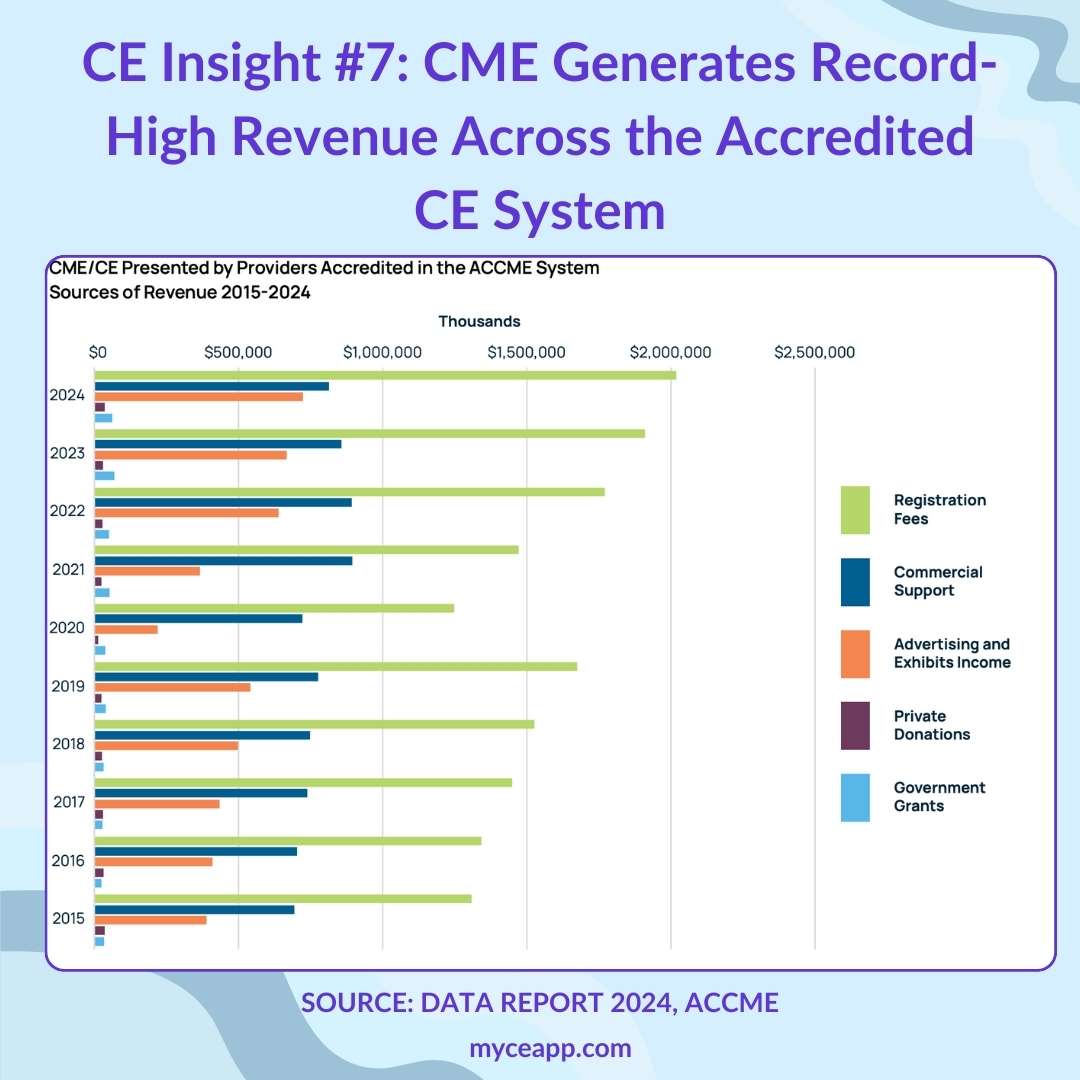
CE Insight #7: CME Generates Record-High Revenue Across the Accredited CE System
ACCME’s 2024 report shows accredited continuing medical education (CME) generated $3.7 billion in total income, the highest in system history. Registration fees accounted for 55% of revenue, while advertising and exhibit income exceeded $725 million (an 8% increase). Only 7% of CME activities received industry support. (Source: Data Report 2024, ACCME)⁴
Implications for Associations and Enterprises: The sustained strength of registration-based and sponsorship-based revenue models highlights opportunities to expandpaid programs, strengthenevent monetization, and maintainindependence from industry funding to build trust.
CE Insight #8: Interprofessional CE (IPCE) Activity Continues Its Upward Growth
Jointly accredited providers delivered 123,175 IPCE activities in 2024, up from 113,934 in 2023 (8.1% YoY growth). These activities reached nearly 34 million learner interactions, underscoring rising demand for team-based, cross-disciplinary learning. (Source: Data Report 2024, ACCME)⁴
Implications for Associations and Enterprises: Growing engagement in interprofessional learning signals opportunitiesto design programs that supportcollaboration, team performance, and cross-functional skills across healthcare and other regulated sectors.
Participation and Enrollment Outlook For 2026
The 2025 data shows that continuing-education providers face uneven enrollment patterns, yet demand for flexible, stackable, and credit-bearing learning pathways continues to rise. Broadening learner profiles across adult learners, alumni, corporate teams, and government professionals points to the need for moresegmented program design. At the same time, rapid growth in micro-credentials, particularly credit-aligned and GenAI-focused options, is accelerating engagement and driving renewed interest in CE programs across institution types.
Associations and enterprises that invest in modern learning infrastructure, multi-tiered credential pathways, and team-based IPCE models will be positioned to serve diverse learner cohorts more effectively. The shift toward modular, outcomes-oriented, and credit-eligible CE is a structural change shaping the future of the sector.
2026 Actionables
Expand credit-bearing and stackable micro-credential offerings to match rising learner expectations.
Enhance data visibility to track segmented enrollment trends across adult, alumni, corporate, and government learners.
Invest in cross-disciplinary and interprofessional learning formats, especially IPCE models.
Modernize registration and delivery experiences to accommodate flexible, modular programs.
Develop employer-aligned pathways that meet workforce upskilling needs and increase engagement.
Licensing, Compliance, and Workforce Development
Mandatory continuing professional development remains a foundational obligation across regulated industries, but the bar for demonstrating impact is rising. Regulators, employers, and learners now expect CE programs to deliver more than fulfilled contact hours; they expect evidence of real-world competence and measurable outcomes.
The following statistics illuminate how compliance-driven CE is evolving alongside workforce readiness demands.
CE Insight #9: Mandatory Continuing Education Remains Strong in Licensed Professions
The U.S. accounting sector is projected to grow at a 7.44% CAGR, with 671,855 licensed CPAs in 2024 who must complete continuing professional education (CPE) to maintain their credentials. (Source: U.S. Continuing Education Market Research Report 2025-2030, Research and Markets)3
Implications for Associations and Enterprises: Professionally licensed industries offer stable CE demand, creating opportunities for providers that deliver compliance-aligned, credit-approved, and profession-specific education.
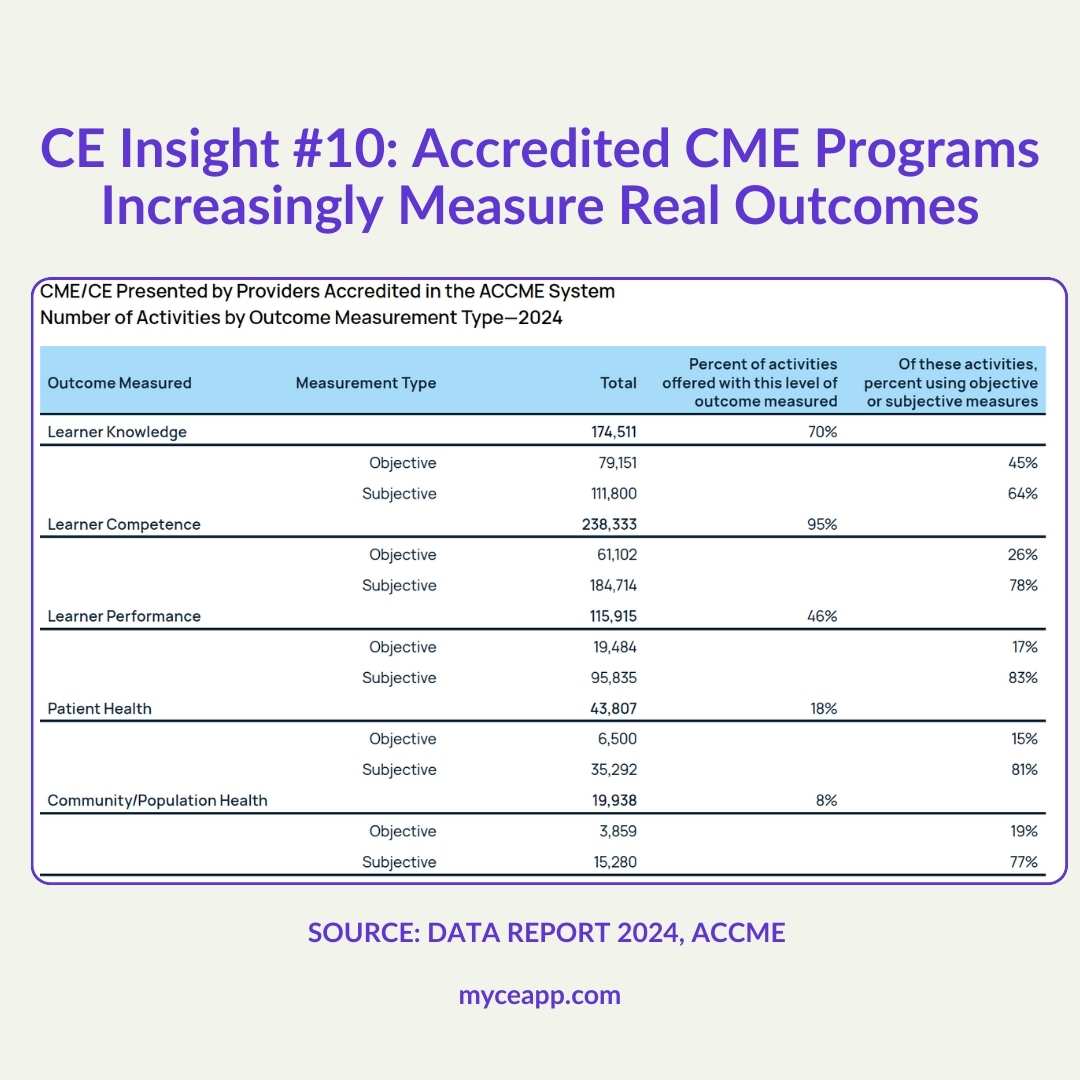
CE Insight #10: Accredited CME Programs Increasingly Measure Real Outcomes
In 2024, 95% of accredited CME activities measured learner competence, 46% evaluated clinician performance, 18% tracked patient health, and 8% assessed community or population healthoutcomes. (Source: Data Report 2024, ACCME)⁴
Implications for Associations and Enterprises: The shift toward outcomes-based CE reinforces the need for programs that demonstrate measurable impact, such as improved competence, performance, or population outcomes, rather than relying solely on participation metrics.
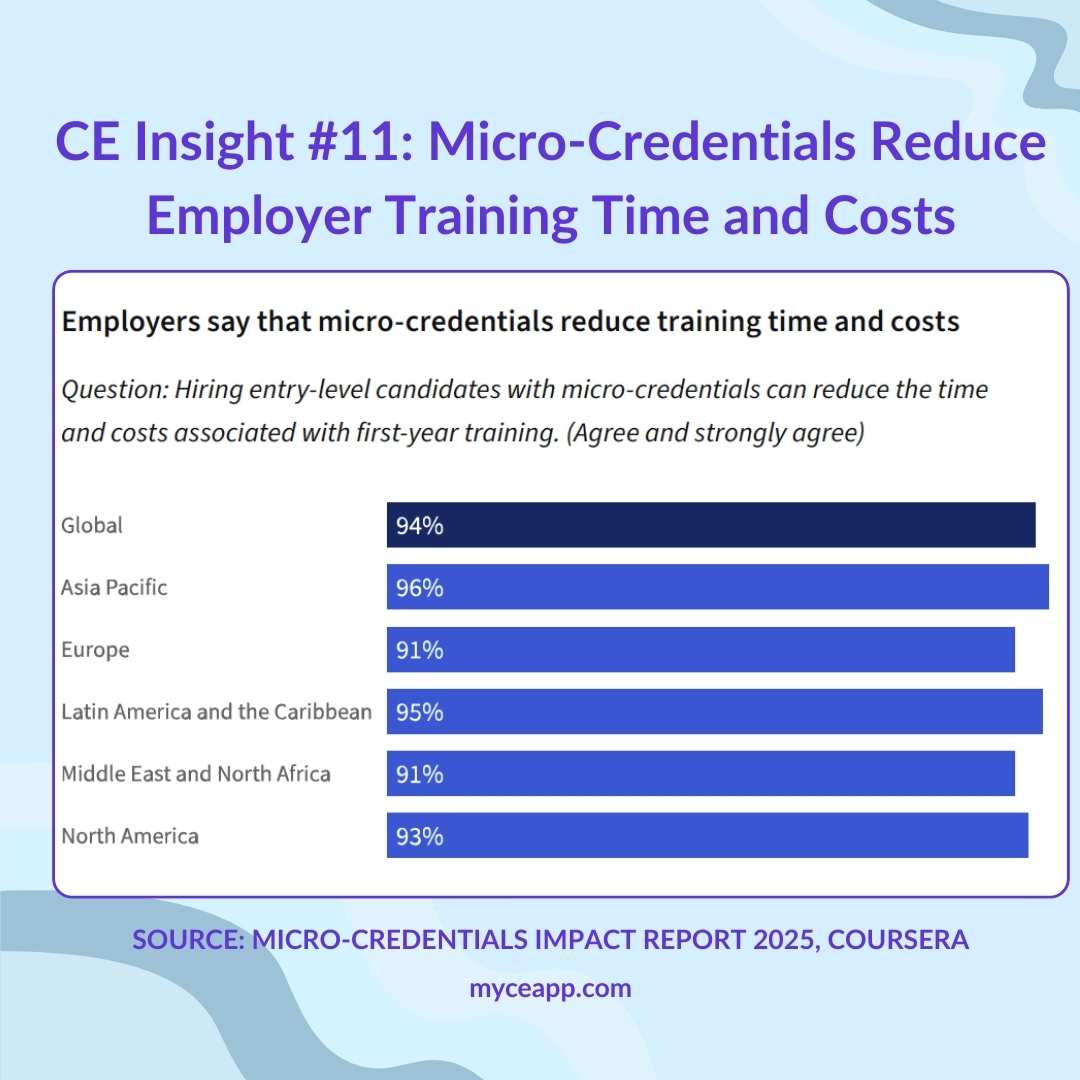
CE Insight #11: Micro-Credentials Reduce Employer Training Time and Costs
Globally, 94% of employers report that hiring candidates with micro-credentials reducestraining time and cost, and 89% confirm measurable cost savings, most commonly in the 10–20% range. (Source: Micro-Credentials Impact Report 2025, Coursera)²
Implications for Associations and Enterprises: Micro-credentials offer a compelling cost-efficiency advantage, enabling CE providers to position credentialed learners as a lower-cost, higher-readiness talent pipeline for employers.
CE Insight #12: The CE Workforce Is Experienced, Stable, and Growing
Preliminary 2025 CPD/CE Workforce Survey results (524 respondents) show net staffing growth, with most program leaders having 15+ years of experience. Additionally, 86%plan to remain in the field, supporting an estimated national workforce of 6,000 CE professionals. (Source: Accredited Continuing Medical Education Delivers 2025, Journal of CME)5
Implications for Associations and Enterprises: A highly experienced and stable CE workforce creates opportunities to implement higher-quality programs, sustain institutional memory, and support continuous improvement across learning systems.
CE Insight #13: Commendation Is Linked to Improved Performance and Health Outcomes
Between 2017 and 2022, 40% of the 122 applicants for ACCME commendation succeeded. Among these organizations, 62% demonstrated improvements in clinician performance, 48% improved healthcare quality, and 31% improved patient or community health outcomes. (Source: Accredited Continuing Medical Education Delivers 2025, Journal of CME)5
Implications for Associations and Enterprises:Recognition programs that reward measurable improvements in performance and quality canaccelerate innovation, strengthen accountability, and reinforceevidence-based CE practices.
Licensing, Compliance, and Workforce Development Outlook For 2026
Continuing education tied to licensure, regulatory compliance, and professional workforce readiness remains a stable and high-demand segment heading into 2026. While micro-credentials and credit-bearing pathways are reshaping learner expectations, compliance-driven CE continues to anchor participation across accounting, healthcare, and other regulated industries.
The data also shows rising expectations for outcomes measurement, with accredited CME increasingly tracking competence, performance, and health outcomes rather than relying solely on attendance. Meanwhile, the CE workforce itself is becoming more experienced, stable, and growth-oriented, providing a solid foundation for program quality and continuity.
Providers that emphasize compliance alignment, outcomes-based education, and experienced staffing models will be better positioned to meet regulatory expectations and support workforce capability in 2026.
2026 Actionables
Prioritize compliance-aligned CE offerings for regulated professions with mandatory education requirements.
Embed outcomes measurement frameworks (competence, performance, quality) to align with evolving CME expectations.
Strengthen workforce capability through experienced CE staff and well-supported program leadership.
Use commendation or recognition pathways to signal program quality and drive internal CE innovation.
Position micro-credentials as compliance-ready tools that reduce employer onboarding and training costs.
Credentialing and Microcredentials
The credential landscape is undergoing rapid evolution as institutions and associations test new formats, delivery models, and pathways. Learners and employers are gravitating toward credentials that offer stackability, accreditation, and clear connections to employment outcomes.
The data that follows captures both the momentum behind these innovations and the operational challenges slowing broader adoption.
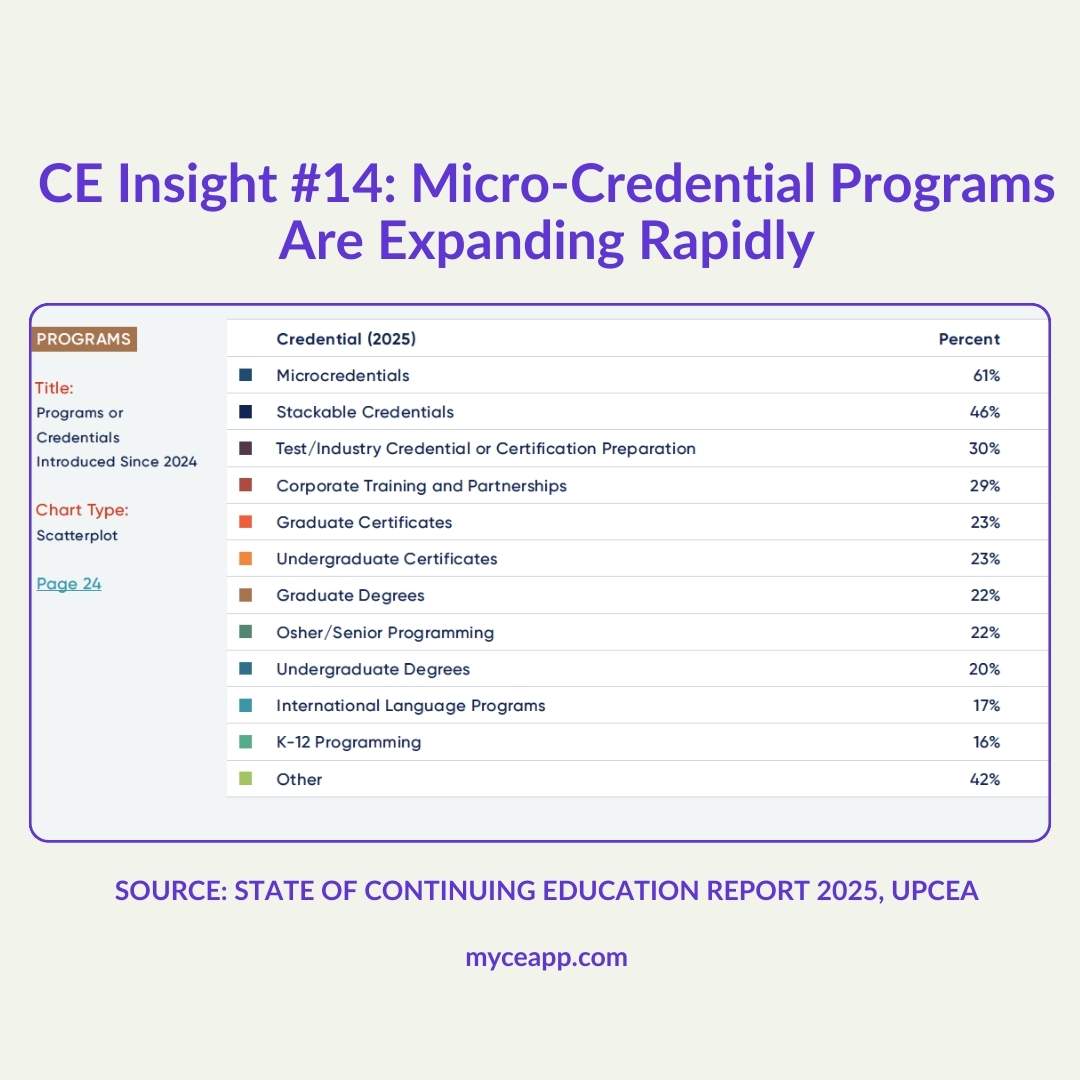
CE Insight #14: Micro-Credential Programs Are Expanding Rapidly
Among UPCEA respondents, 61% introduced newmicro-credentials in the past two years, 46%launchedstackable credentials, and 30%createdtest or industry certification preparation programs. (Source: State of Continuing Education Report 2025, UPCEA)¹
Implications for Associations and Enterprises: The rapid expansion of micro-credential and stackable programs signals rising learner expectations for modular, career-relevant, and progressive credential pathways.
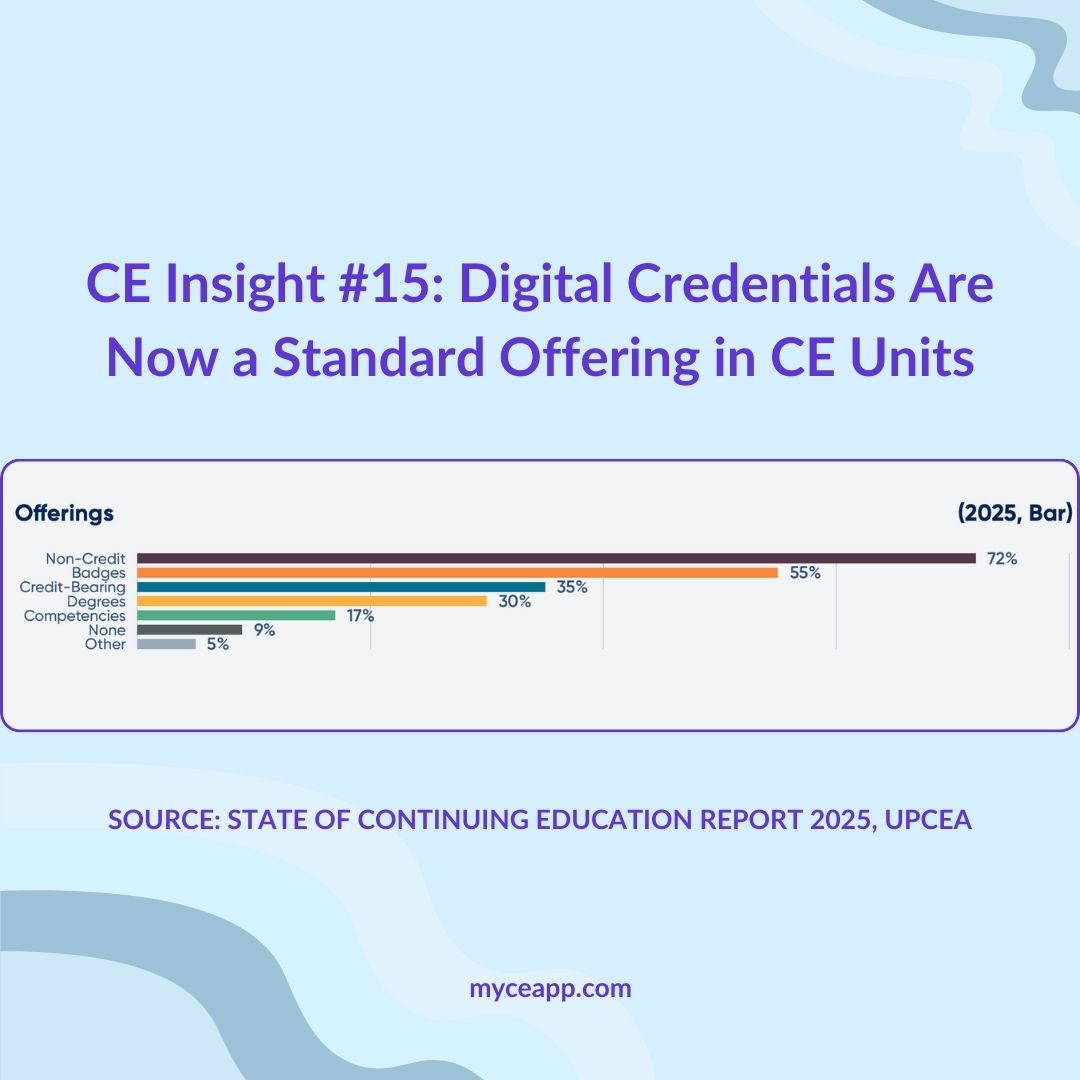
CE Insight #15: Digital Credentials Are Now a Standard Offering in CE Units
Across online and PCE units, 72% offer non-credit certificates, 55% offer digital badges, 35% offer credit-bearing certificates, 30% offer degrees, 17% offer competency-based credentials, and 9% offer none. (Source: State of Continuing Education Report 2025, UPCEA)¹
Implications for Associations and Enterprises: A broad mix of digital certificates, badges, and competency-based credentials suggests the need for flexible product portfolios that meet varied learner needs and verification requirements.
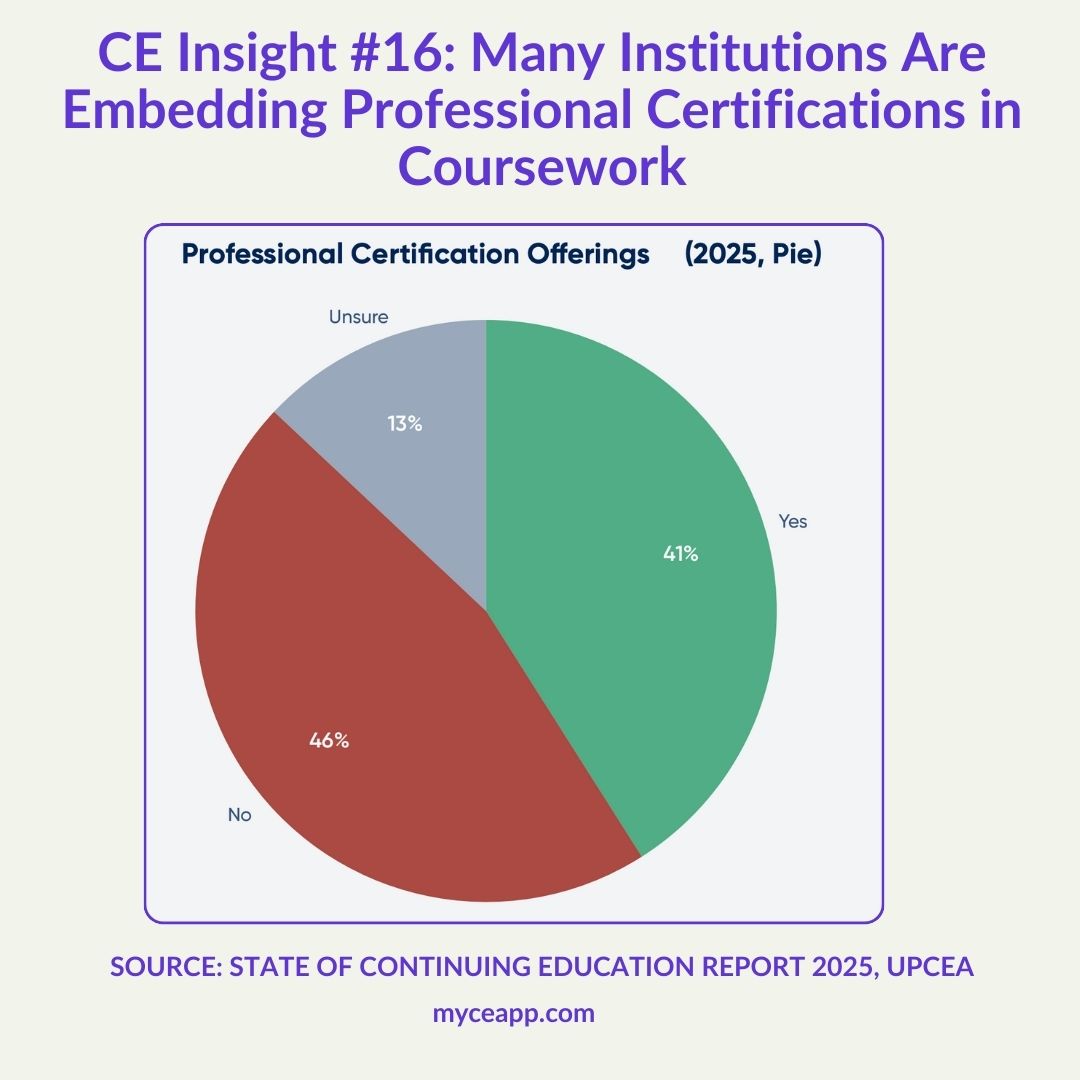
CE Insight #16: Many Institutions Are Embedding Professional Certifications in Coursework
Among PCE units, 41% embed professional certifications within courses, while 46%donot, and 13% are unsure. Of those embedding certifications, 67% integrate business or management certifications, 60% incorporate technology certifications, and 47% embed healthcare certifications. (Source: State of Continuing Education Report 2025, UPCEA)¹
Implications for Associations and Enterprises: Embedding industry-recognized certifications into learning pathways strengthens program relevance and expands opportunities for co-branded or partner-driven credentialing models.
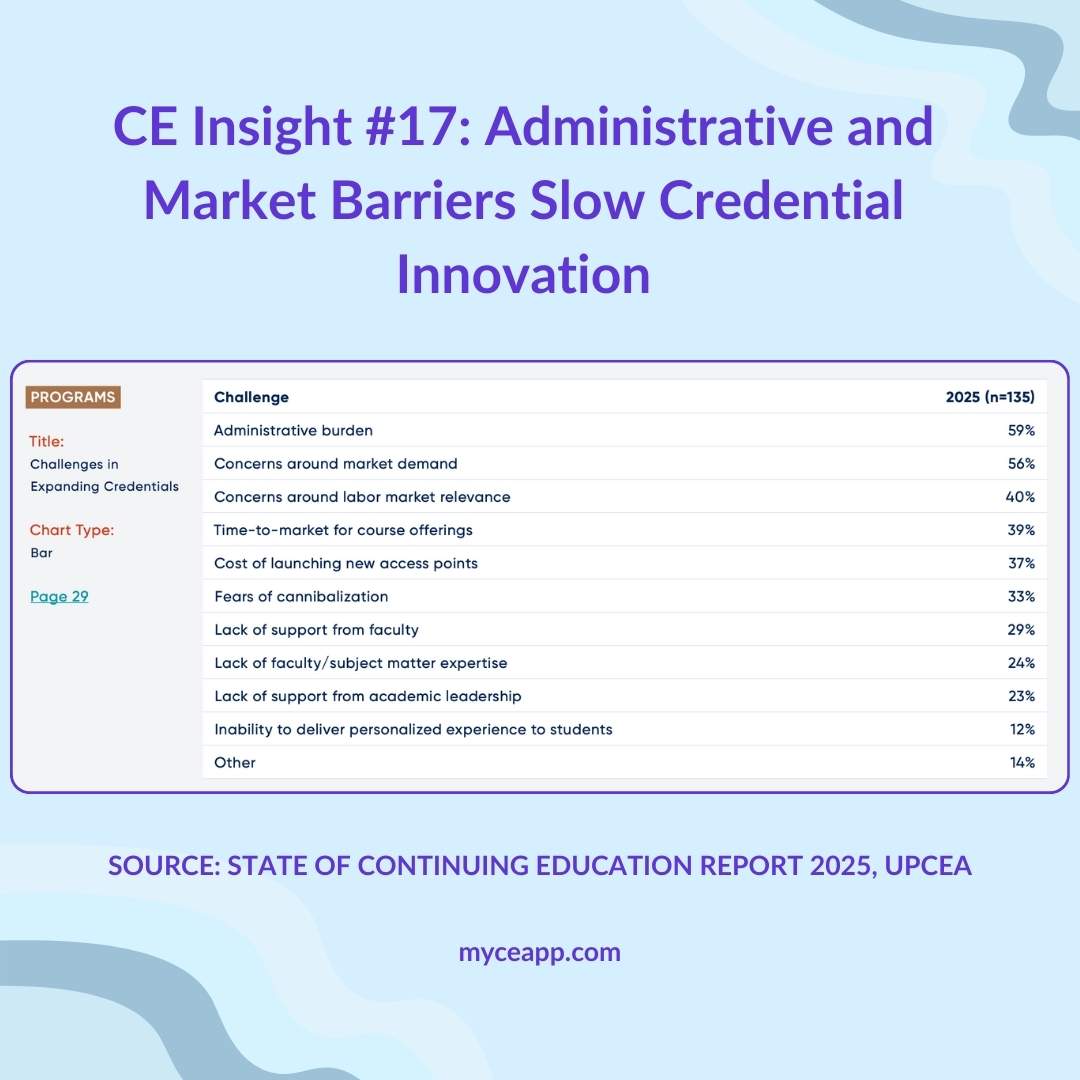
CE Insight #17: Administrative and Market Barriers Slow Credential Innovation
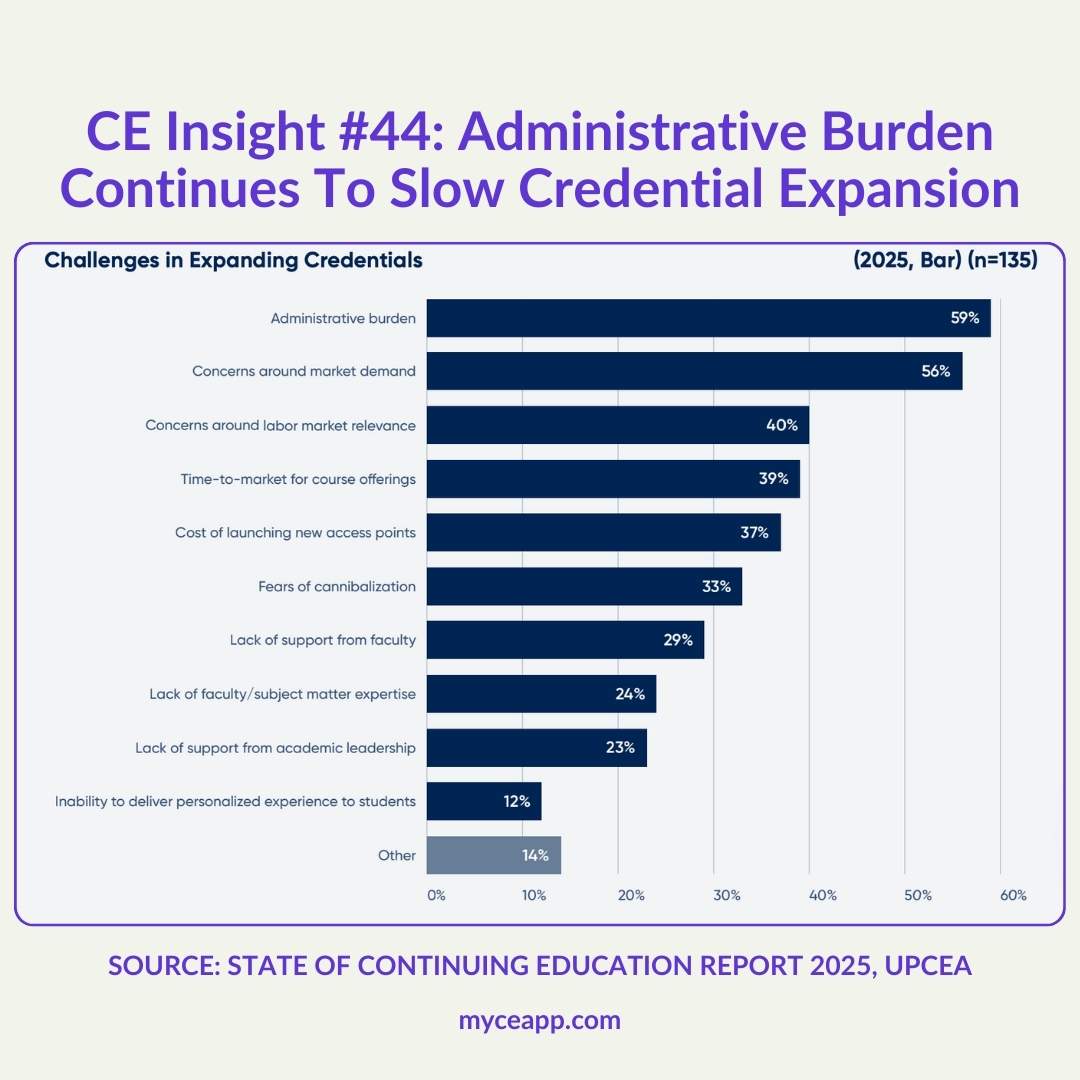
Institutions cite several barriers to expanding credential offerings: 59% report administrative burden, 56% cite market demand uncertainty, 40% note labor-market relevance concerns, 39% face time-to-market challenges, and 37% cite cost of launching new access points. (Source: State of Continuing Education Report 2025, UPCEA)¹
Implications for Associations and Enterprises: Reducing administrative complexity, validating market demand, and improving time-to-market processes will be essential for scaling new credential offerings in 2026.
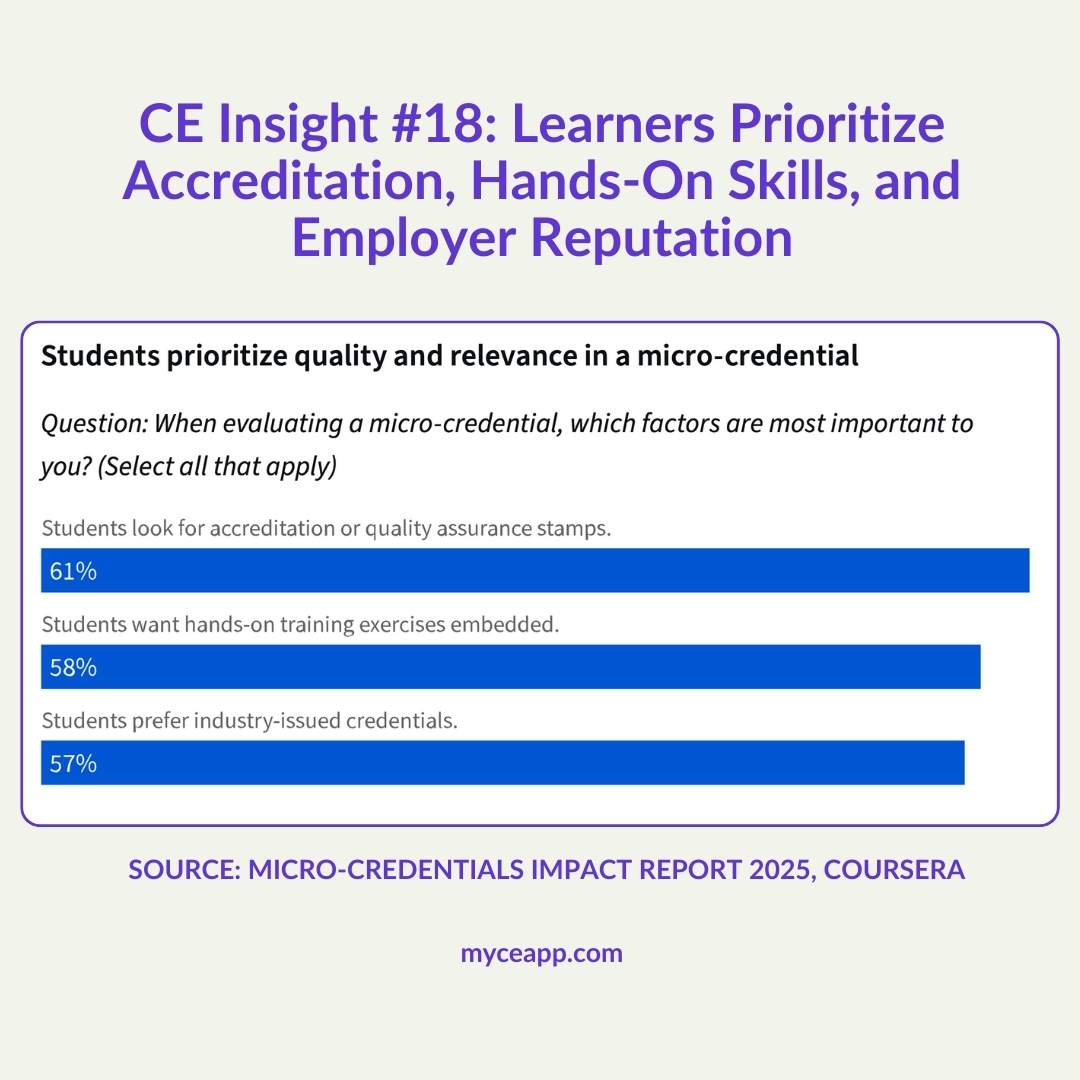
CE Insight #18: Learners Prioritize Accreditation, Hands-On Skills, and Employer Reputation
When selecting micro-credentials, 61% of students prioritize accreditation or quality assurance, 58% value hands-on training, and 57% consider employer reputation important. Two-thirds of students and three-quarters of employees who earn a micro-credential go on to earn additional credentials. (Source: Micro-Credentials Impact Report 2025, Coursera)²
Implications for Associations and Enterprises: Learners expect credentials that deliver quality assurance, practical skill-building, and strong employer recognition, making these elements essential for competitive CE programs.
CE Insight #19: Stackable Credentials Drive Repeat Enrollment
Among micro-credential earners, two-thirds of students and 75% of entry-level employees pursue additional credentials, reinforcing the value of stackable learning pathways. (Source: Micro-Credentials Impact Report 2025, Coursera)²
[Note: This reinforces the repeat participation trend highlighted in CE Insight #5.]
Implications for Associations and Enterprises: Clear, multi-step credential roadmaps can encouragerepeat enrollment, increaselifetime learner value, and deepencareer progression pathways.
CE Insight #20: Credit-Bearing Micro-Credentials Increase Enrollment and Retention
Among higher-education leaders, 75% report that students are more likely to enroll when micro-credentials carry academic credit, and 80%saycredit-bearing credentials improveretention. (Source: Micro-Credentials Impact Report 2025, Coursera)²
Implications for Associations and Enterprises: Credit-bearing micro-credentials can strengthenprogram attraction, completion rates, and learner loyalty, making them valuable additions to CE portfolios.
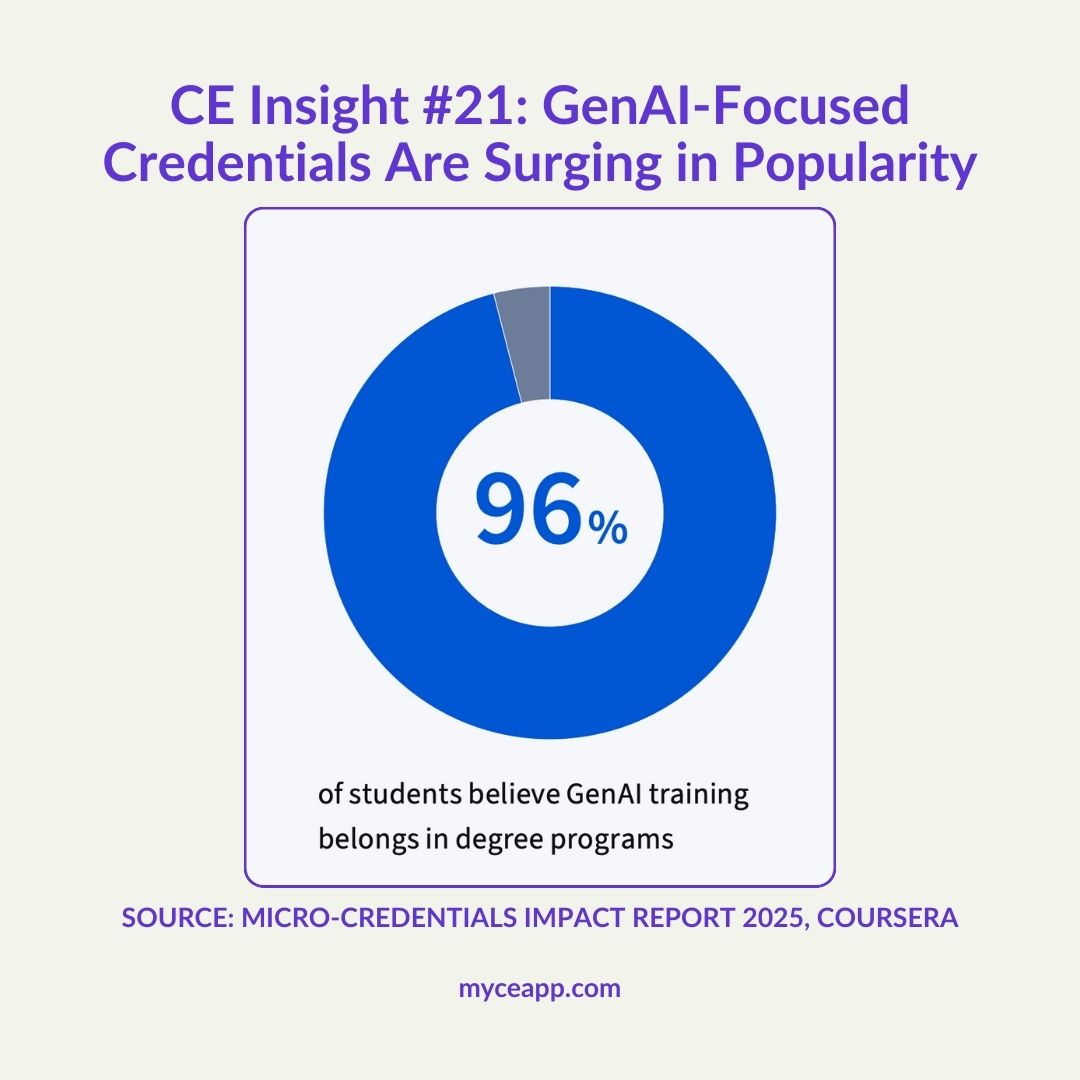
CE Insight #21: GenAI-Focused Credentials Are Surging in Popularity
Across learners, 86% consider GenAI skillsessential. 17% have earneda GenAI micro-credential, and 96% believe GenAI training should be part of degree programs. Nearly 90% of GenAI credential earners report improved skills, and 92% of employersprefer a less experienced candidate with a GenAI credential over a more experienced candidate without one. (Source: Micro-Credentials Impact Report 2025, Coursera)²
Implications for Associations and Enterprises: Launching GenAI-aligned credentialscan help close workforce capability gaps and position learning providers as leaders in future-focused skill development.
CE Insight #22: Employer Demand for GenAI Skills Outpaces Supply
74% of employers struggle to source GenAI talent, and 94% believe universities should equip graduates with GenAI skills. Meanwhile, only 33% of entry-level employeesreceiveGenAI training, despite 69% wanting it. (Source: Micro-Credentials Impact Report 2025, Coursera)²
Implications for Associations and Enterprises: A clear supply-demand gap in GenAI capability creates opportunities for CE providers to deliver high-demand GenAI upskilling pathways.
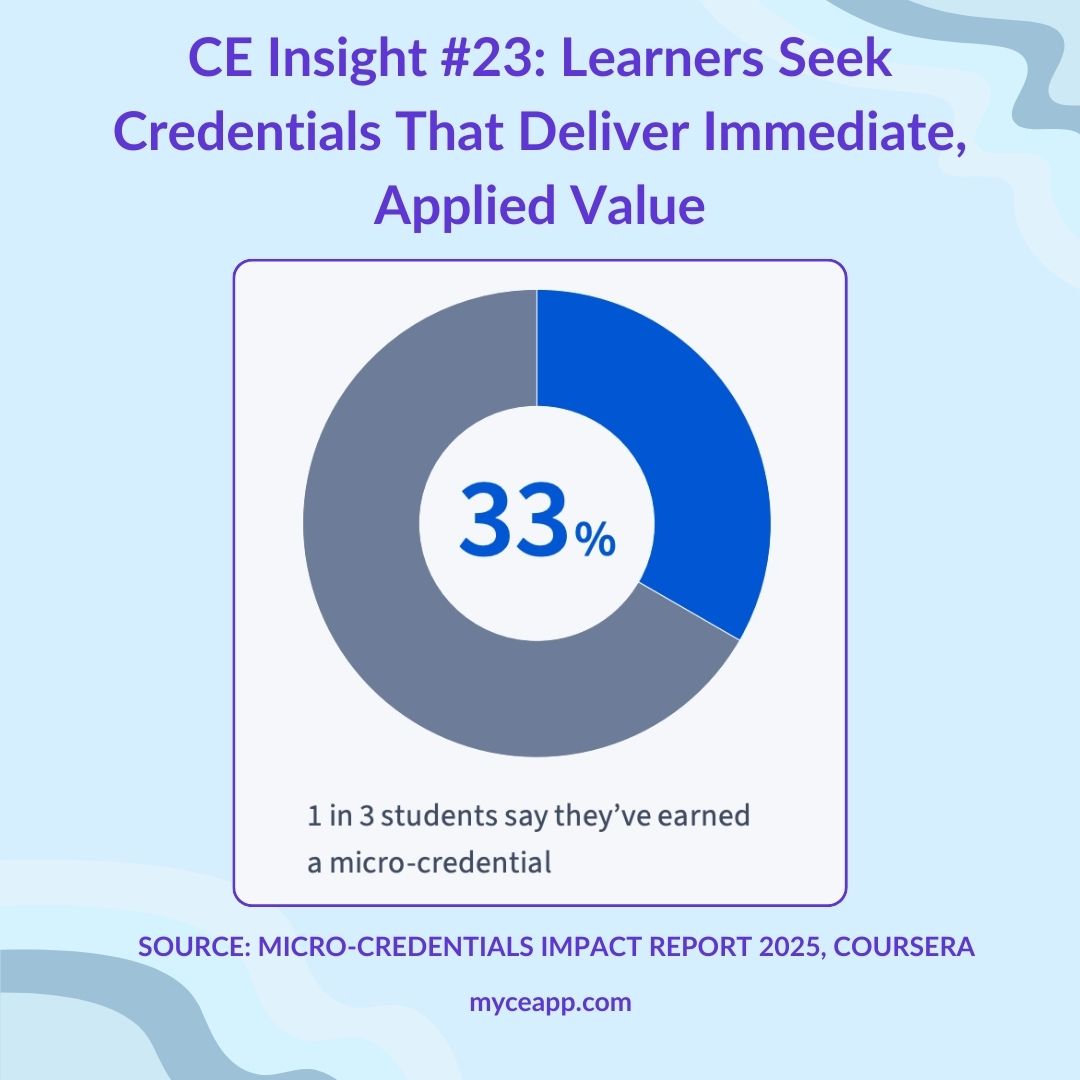
CE Insight #23: Learners Seek Credentials That Deliver Immediate, Applied Value
Students prioritize quality assurance (61%), hands-on application (58%), and employer reputation (57%) when assessing micro-credentials. 33% of students report earning a micro-credential, and 25% of entry-level employees have earned one on the job. (Source: Micro-Credentials Impact Report 2025, Coursera)²
[Note: See also CE Insight #18 for additional context on learner credential preferences.]
Implications for Associations and Enterprises:Innovative CE programs that emphasize practical skill development, verified quality, and strong employersignaling will attract learners seeking rapid, job-relevant impact.
Credentialing and Microcredentials Outlook For 2026
The data shows a decisiveshifttowardstackable, credit-bearing, and career-aligned micro-credentials, with learners consistently prioritizingquality assurance, hands-on training, and employer recognition. Rapid GenAI adoption is also creating new demand for future-critical skills, while institutions continue to face administrative bottlenecks that slow credential innovation.
As micro-credentials become a primary vehicle for skill verification, upskilling, and workforce mobility, both associations and enterprises will need to maintainquality standards, expand credential pathways, and align closely with employer expectations.
2026 Actionables
Prioritize credit-bearing and stackable micro-credentials to strengthen enrollment and retention.
Develop GenAI-aligned credential options to meet rapidly growing employer demand.
Expand partnerships with certifying bodies for embedded and co-branded credentials.
Streamline administrative processes to reduce friction in launching new credentials.
Emphasize hands-on, employer-recognized competencies in program design.
Technology, Automation, and Tracking
Artificial intelligence and automation are reshaping the skills employers need and the infrastructure required to deliver modern CE. Learners expect technology-enabled experiences that offer flexibility, personalization, and immediate value, while employers are planning aggressive upskilling strategies to address accelerating skill obsolescence.
The following set of statistics examines how technological change is influencing both program demand and operational capacity.
CE Insight #24: AI Adoption Will Transform Nearly 40% of Workforce Skills by 2030
Employers estimate that 39% of workers’ existing skills will be transformed or obsolete by 2030 (down from 44% in 2023), partly because 50% of workers have already completed some form of reskilling or upskilling. (Source: The Future of Jobs Report 2025, WEF)6
Implications for Associations and Enterprises: The accelerating pace ofskill transformation underscores the need for CE providers to offer continuous reskilling, modular updates, and future-oriented training that helps learners keep pace with automation.
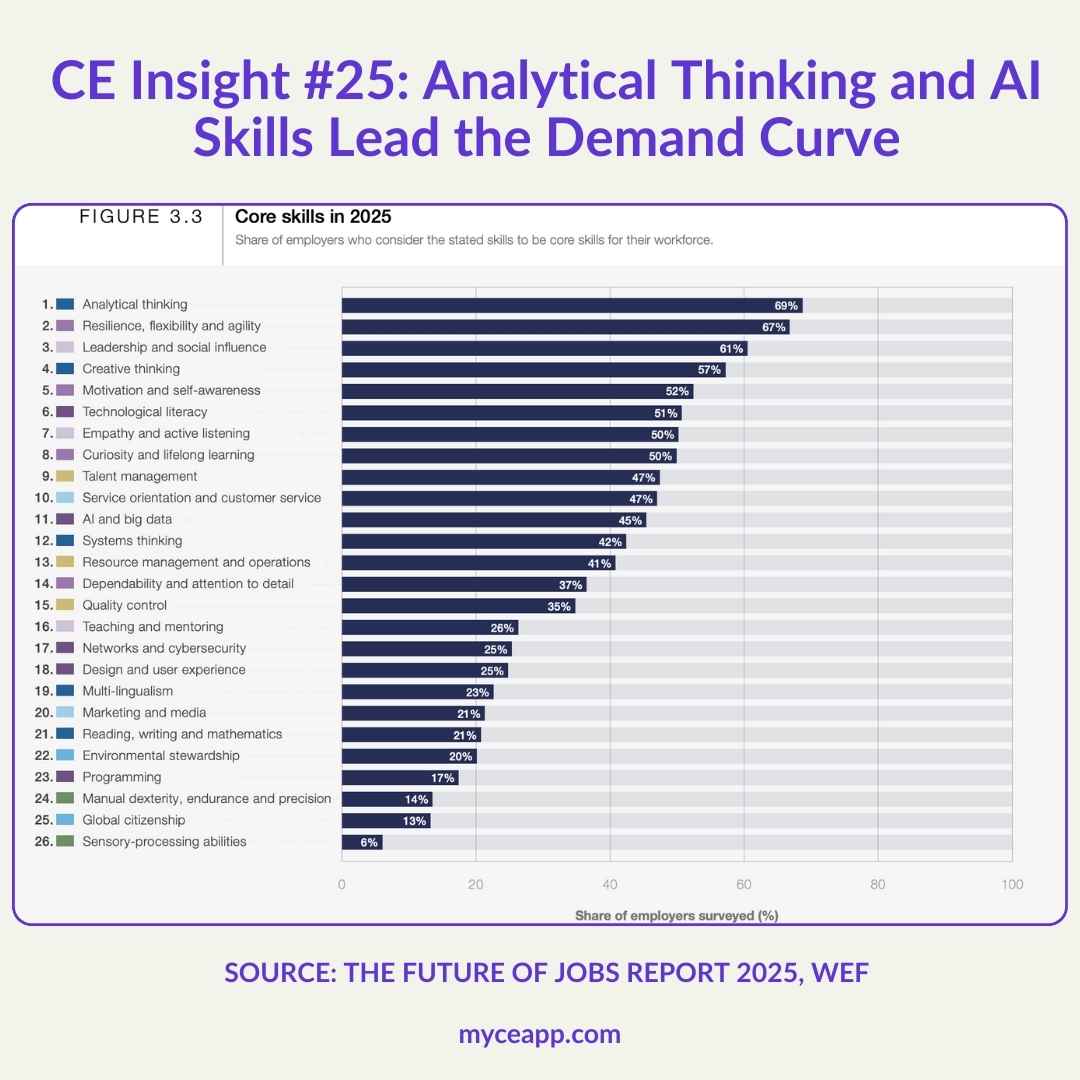
CE Insight #25: Analytical Thinking and AI Skills Lead the Demand Curve
70% of companies rateanalytical thinkingasessential. Employers also increasingly valueresilience, agility, and leadership, while AI/big data, cybersecurity, and tech literacy rank among the fastest-growing skill areas. (Source: The Future of Jobs Report 2025, WEF)6
Implications for Associations and Enterprises: Programs that combinetechnical skills (AI, big data, cybersecurity) withcore cognitive and leadership skills will meet employer demand and enhance learner competitiveness.
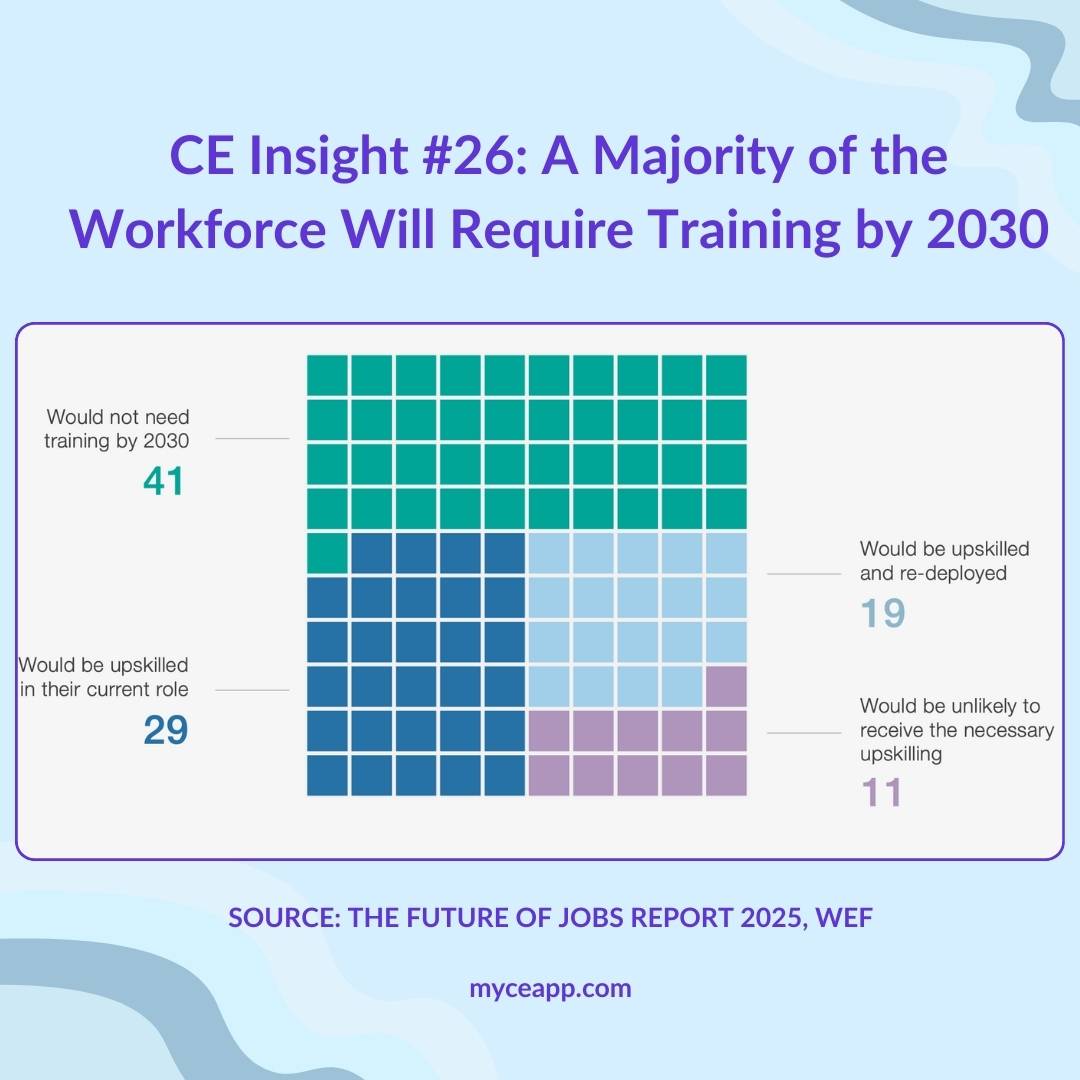
CE Insight #26: A Majority of the Workforce Will Require Training by 2030
By 2030, only 41% of workers will not require training. 29% can be upskilled in their current roles, 19% can be upskilled and redeployed, and 11% are unlikely to receive training at all. (Source: The Future of Jobs Report 2025, WEF)6
Implications for Associations and Enterprises: CE providers must design programs that address both upskilling and reskilling, including support for workers at risk of training exclusion.
CE Insight #27: Employers Are Taking Aggressive Action on Talent Transformation
63% of employers cite skill gaps as the biggest barrier to transformation. In response, 85% plan to prioritize upskilling, 70% expect to hire staff with new skills, 50% will transition staff into new roles, and 40% plan to reduce roles requiring obsolete skills. (Source: The Future of Jobs Report 2025, WEF)6
Implications for Associations and Enterprises: Organizations need CE partnersthatdeliverscalable upskilling, supportrole transitions, and helpemployers addresspersistentskill gaps.
CE Insight #28: Employers Are Prioritizing Workforce Well-Being and DEI
64% of employers consider employee health and well-being essential for attracting talent. 83% have DEI initiatives, including 96% of North American companies and 95% of organizations with more than 50,000 employees. (Source: The Future of Jobs Report 2025, WEF)6
Implications for Associations and Enterprises:Integratingwell-being, psychological safety, and inclusive learning design into CE can align program offerings with employer priorities.
CE Insight #29: AI Is Reshaping Business Strategy and Talent Allocation
By 2030, 52% of employers plan to allocate a greater share of revenue towages, 50% expect to reorient business models due to AI, 66% will hire AI-skilled talent, and 40% anticipate reducing roles automated by AI. (Source: The Future of Jobs Report 2025, WEF)6
Implications for Associations and Enterprises: Increased automation creates demandfor CE programs focused on AI literacy, data-driven decision-making, and role-transition training.
CE Insight #30: GenAI Credentials Improve Productivity and Problem-Solving
Among entry-level employees, 24% have earnedaGenAI micro-credential. Of these, 70%reportincreasedproductivity, and 63%reportimprovedproblem-solving. Even without a credential, 77% of employees expect GenAI upskilling to improve productivity. (Source: Micro-Credentials Impact Report 2025, Coursera)²
Implications for Associations and Enterprises: GenAI-focused credentials provide measurableproductivity benefits, enabling CE providers to position themselves as high-value workforce accelerators.
CE Insight #31: A Significant GenAI Training Gap Persists in Entry-Level Talent
Only 33% of entry-level employees receiveGenAI training from employers, even though 69% want it and 96% of employers say they are willing to provide it. (Source: Micro-Credentials Impact Report 2025, Coursera)²
Implications for Associations and Enterprises: There is a clear opportunity for CE providers to deliver accessible GenAI training that helps employers close this readiness gap.
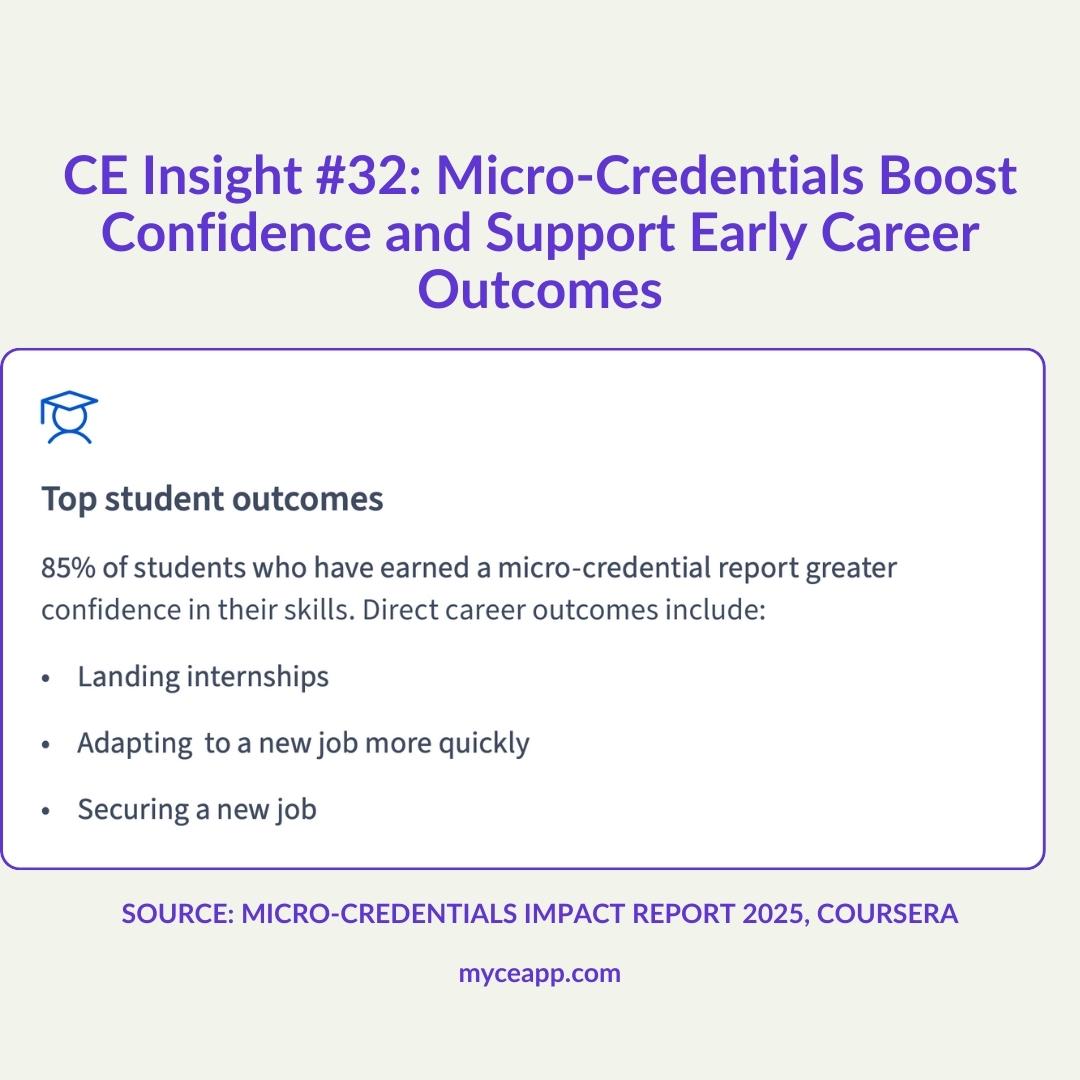
CE Insight #32: Micro-Credentials Boost Confidence and Support Early Career Outcomes
Among students who earned a micro-credential, 85%report greater confidence, 31%secured aninternship, and 21%adapted more quickly to new roles. Among entry-level employees, 28% received a pay increase, and 21% received a promotion due to micro-credentials. (Source: Micro-Credentials Impact Report 2025, Coursera)²
Implications for Associations and Enterprises: Micro-credentials can strengthen learner confidence, improve career mobility, and deliver measurable employment outcomes.
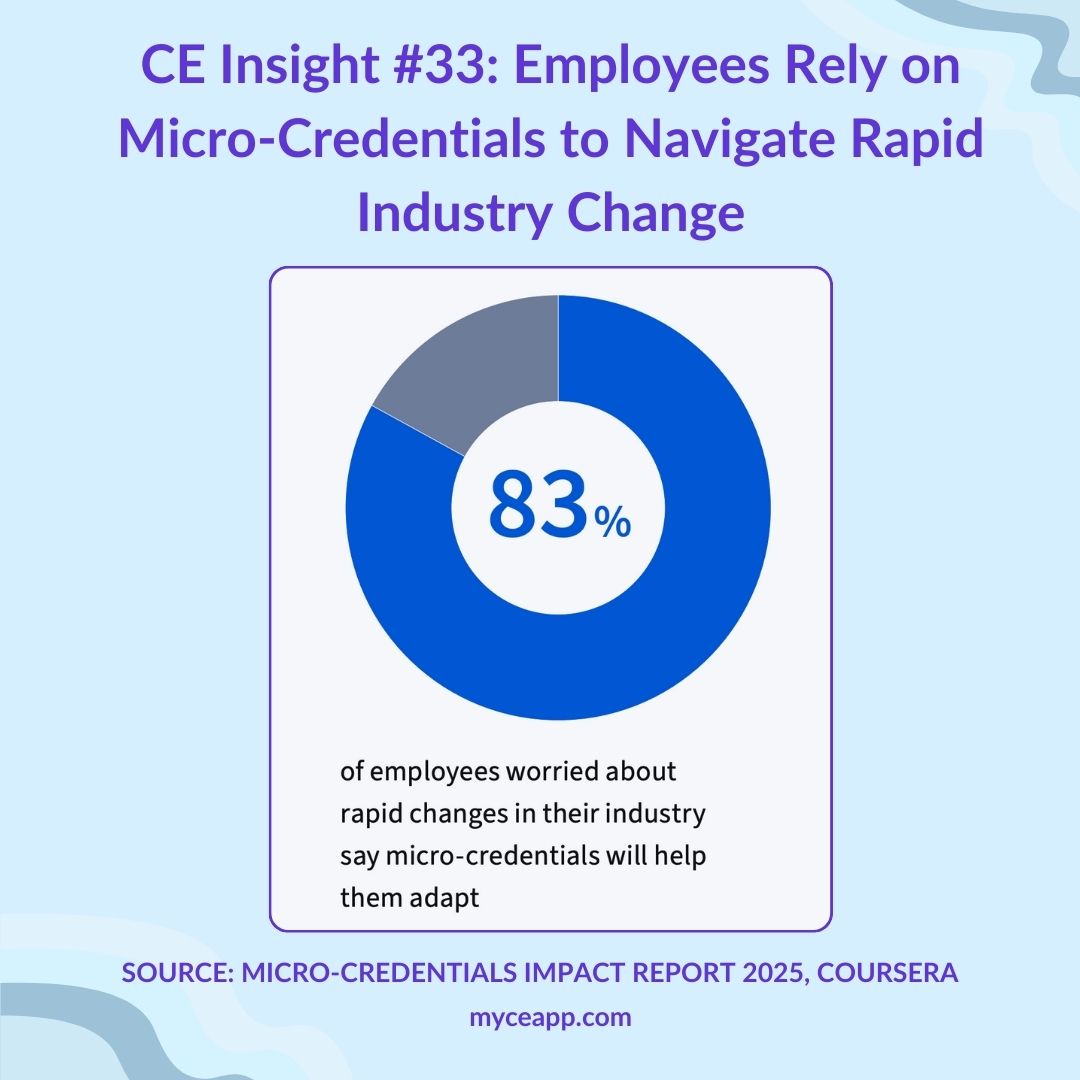
CE Insight #33: Employees Rely on Micro-Credentials to Navigate Rapid Industry Change
71% of entry-level employees are concerned about the pace of industry change, and 83% believe that micro-credentials improve their ability to adapt. (Source: Micro-Credentials Impact Report 2025, Coursera)²
Implications for Associations and Enterprises: CE programsthatbuildadaptability, resilience, and verified skill development can support learners navigating fast-changing work environments.
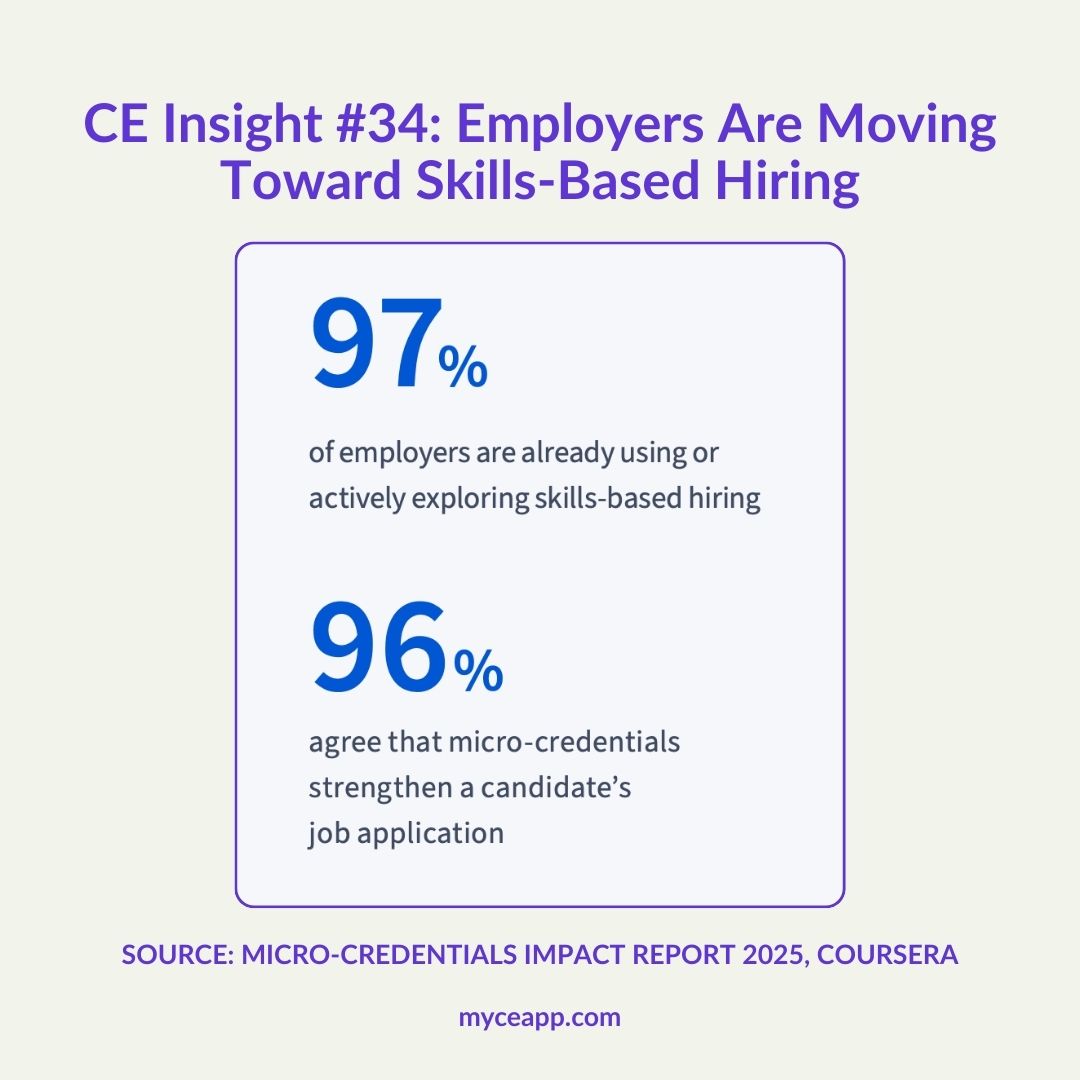
CE Insight #34: Employers Are Moving Toward Skills-Based Hiring
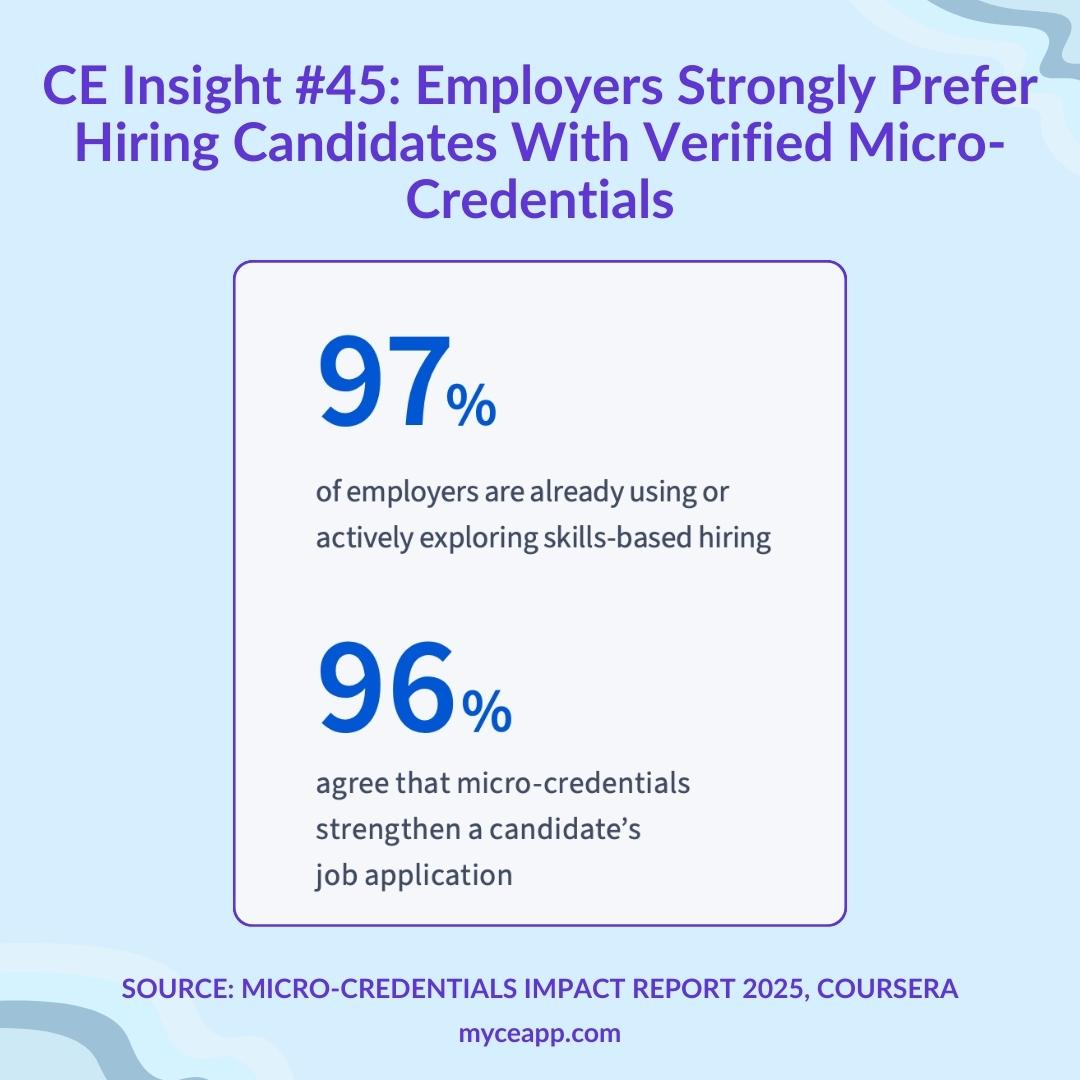
97% of employers are already using or actively exploring skills-based hiring (a 20-point increase since 2023). 96%agree that micro-credentials strengthen a candidate’s application, and 87% have hired at least one micro-credential holder in the past year. (Source: Micro-Credentials Impact Report 2025, Coursera)²
Implications for Associations and Enterprises: The shift to skills-based hiring makes verifiable, transparent credentials central to employability, creating strong demand for CE programs that deliver clearly documented competencies and signal-rich micro-credentials.
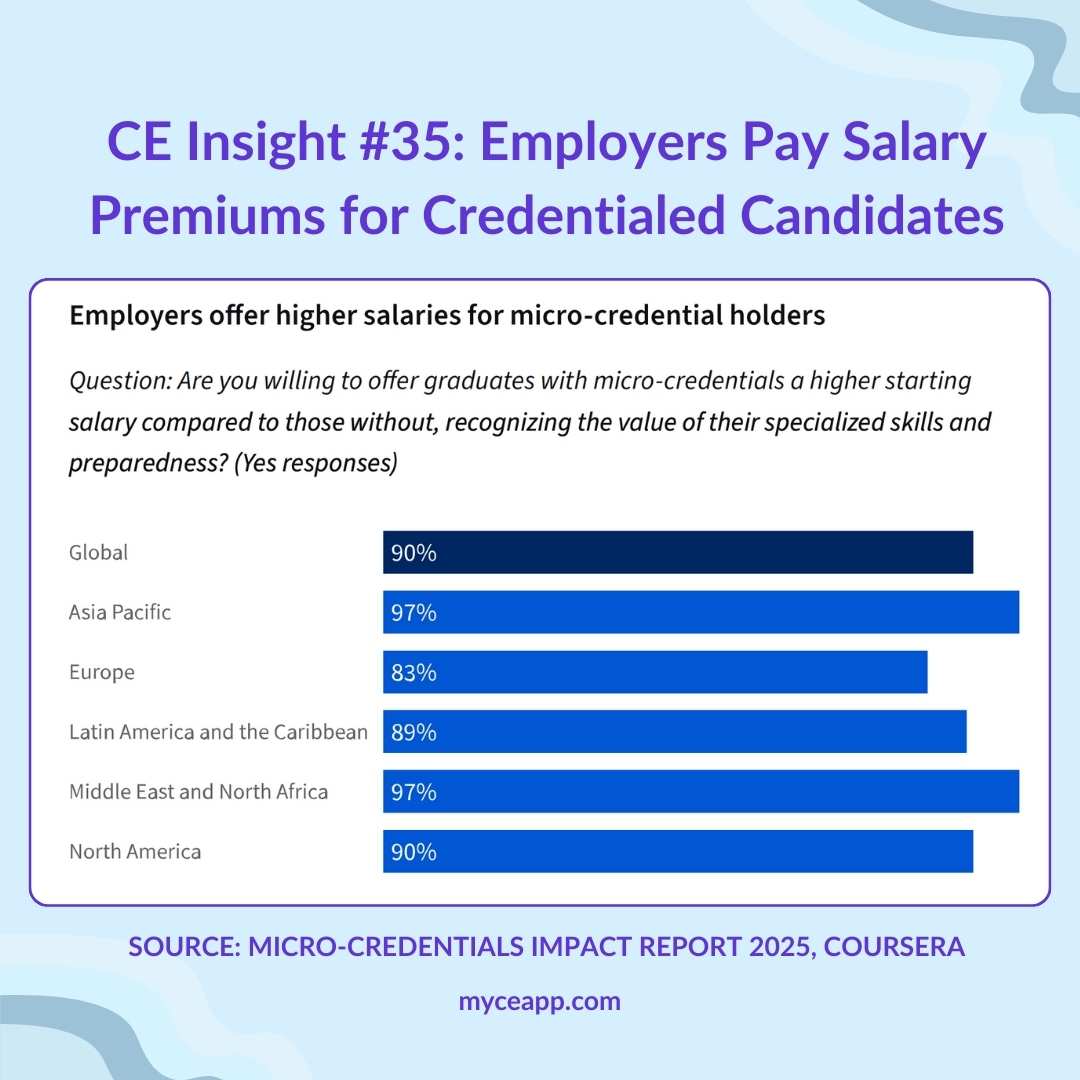
CE Insight #35: Employers Pay Salary Premiums for Credentialed Candidates
Globally and in the U.S., 90% of employers are willing to offer candidateswith micro-credentials higher starting salaries, typically in the 10–15% premium range. (Source: Micro-Credentials Impact Report 2025, Coursera)²
Implications for Associations and Enterprises: Salary premiums for credentialed talent provide a strong value story for learners and employers, enabling CE providers to position their programs as a direct contributor to earnings and career advancement.
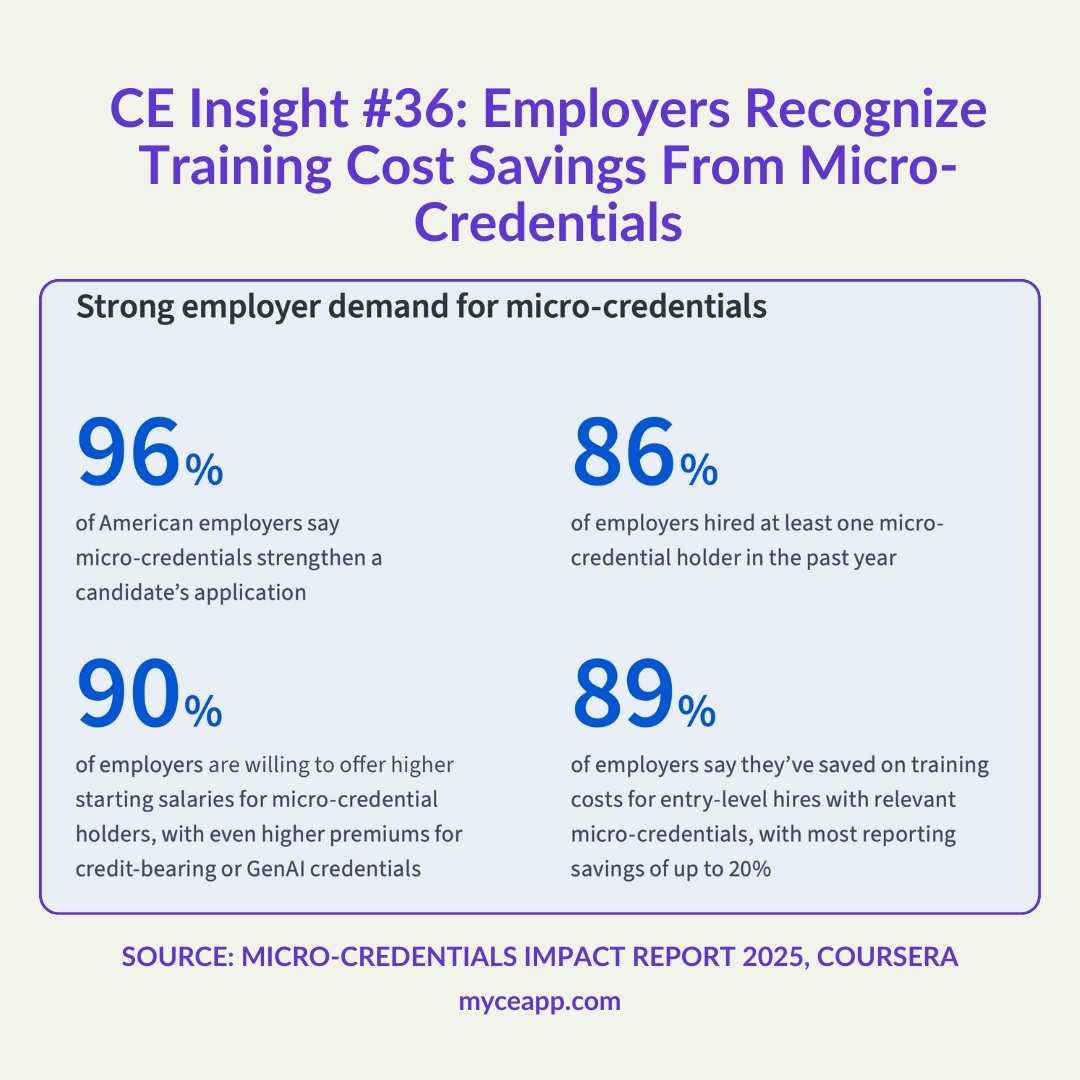
CE Insight #36: Employers Recognize Training Cost Savings From Micro-Credentials
In the U.S., 89% of employers report training cost savings for entry-level hires who hold micro-credentials, with most savings reported at up to 20%. (Source: Micro-Credentials Impact Report 2025, Coursera)²
Implications for Associations and Enterprises: By producing job-ready, credentialed candidates, CE programs can help employers reduce onboarding and training costs, strengthening the business case for employer-sponsored participation.
CE Insight #37: Employees Strongly Want Employer Support for Advanced Credentials
Among entry-level employees without GenAI training, 69% say they would like their employers to support GenAI training, indicating strong demand for employer-funded upskilling. (Source: Micro-Credentials Impact Report 2025, Coursera)²
Implications for Associations and Enterprises: High interest in employer-funded GenAI and credential training opens the door for CE providers to design co-branded upskilling programs, employer partnerships, and enterprise-wide learning solutions.
Technology, Automation, and Tracking Outlook For 2026
The 2025 data shows that AI adoption, automation, and skills-based hiring are fundamentally reshaping workforce development. Employers expect nearly 40% of workforce skills to be transformed by 2030, areprioritizinganalytical thinking, AI literacy, and cybersecurity, and are planning aggressive upskilling and role transitions. At the same time, GenAI credentials and micro-credentials are delivering measurable gains in productivity, confidence, and career mobility, while offering employers training cost savings and the ability to pay salary premiums for verified skills.
As organizations move toward skills-first talent strategies, CE providers that combine AI-enabled training, outcomes-based micro-credentials, and robust tracking of competencies will be best positioned to support employers and learners navigating rapid transformation.
2026 Actionables
Develop AI and GenAI-aligned credentials that directly support the fastest-growing skill demands.
Design reskilling and role-transition pathways for workers impacted by automation and changing job profiles.
Align CE offerings with skills-based hiring, using micro-credentials to clearly document verifiable competencies.
Highlight employer ROI by demonstrating training cost savings and improved productivity outcomes from credentialed learners.
Deepen enterprise partnerships to deliver employer-funded GenAI and micro-credential programs at scale.
Staffing and Operations
Behind every successful CE program is an infrastructure that supports agile decision-making, efficient administration, and reliable data visibility. Yet many CE units face a persistent gap between strategic expectations and the resources available to meet them.
The statistics in this section reveal where operational investments are most urgently needed to sustain scalable, high-quality program delivery.
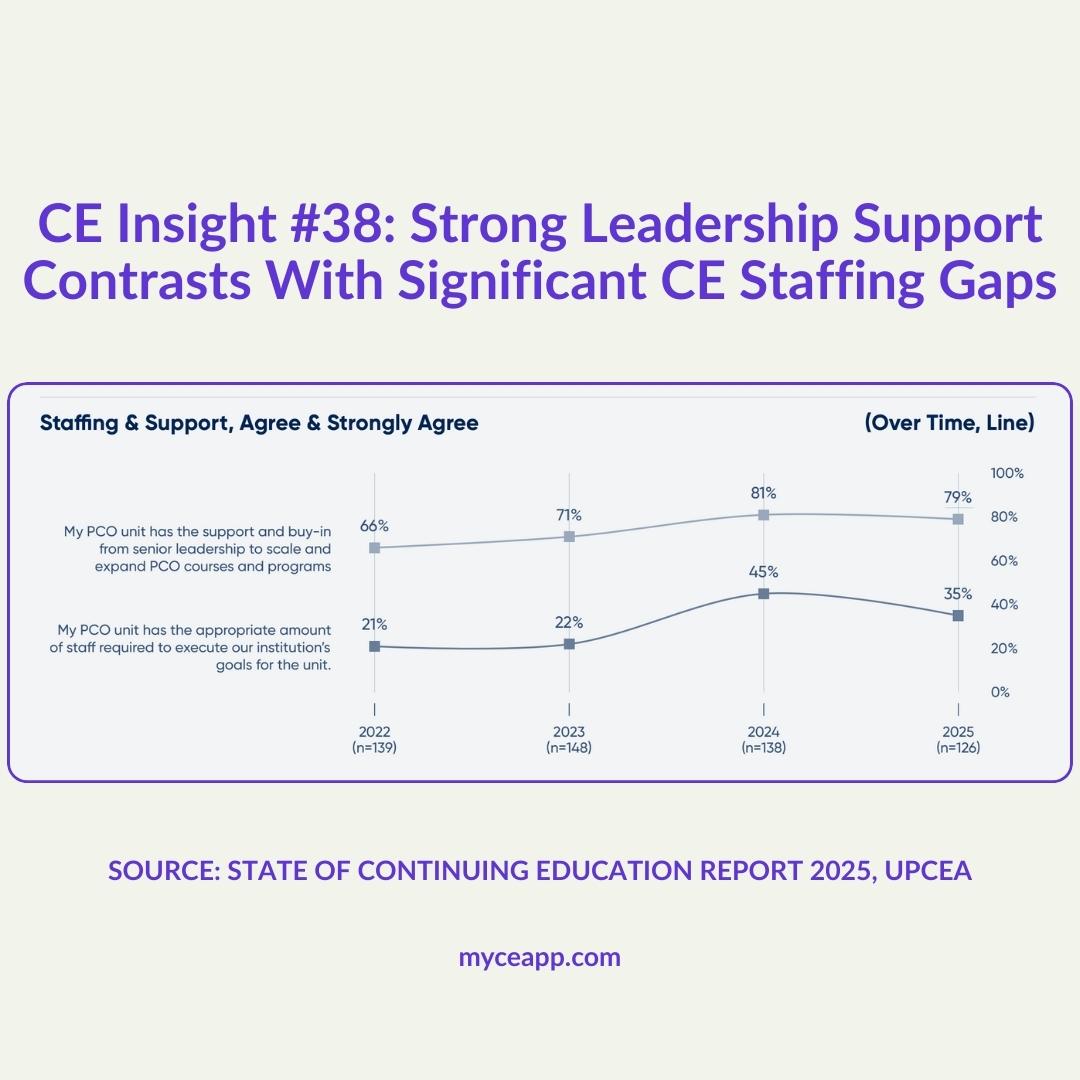
CE Insight #38: Strong Leadership Support Contrasts With Significant CE Staffing Gaps
79% of UPCEA respondents agree their PCE unit has strong senior leadership support, and 69% agree it is revenue-generating. Despite this, only 35% feel they have adequate staff. Key staffing gaps include finance/business analysts (27%), program managers/directors (17%), marketing (14%), instructional design (13%), and technology/data roles (12%). (Source: State of Continuing Education Report 2025, UPCEA)¹
Implications for Associations and Enterprises:Sustained program growth requires strengthening specialized roles in finance, instructional design, marketing, and data, ensuring CE units can scale with rising strategic expectations.
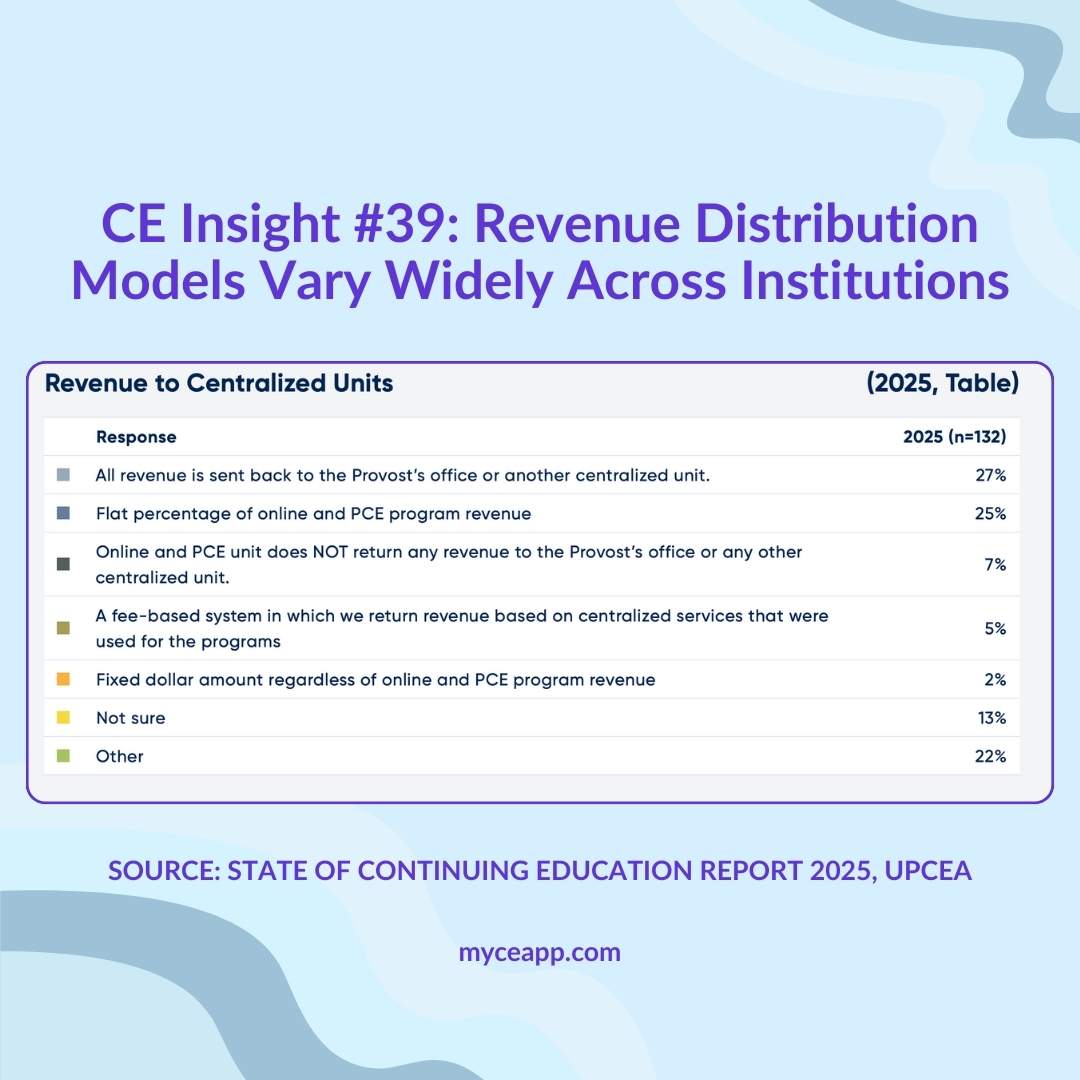
CE Insight #39: Revenue Distribution Models Vary Widely Across Institutions
Institutions differ significantly in how they distribute CE revenue: 27% send all revenue to central administration, 25% send a flat percentage, and 7% retain all revenue within the unit. (Source: State of Continuing Education Report 2025, UPCEA)¹
Implications for Associations and Enterprises:Understanding and negotiating revenue flows is essential for financial sustainability, particularly when scaling new programs or expanding digital offerings.
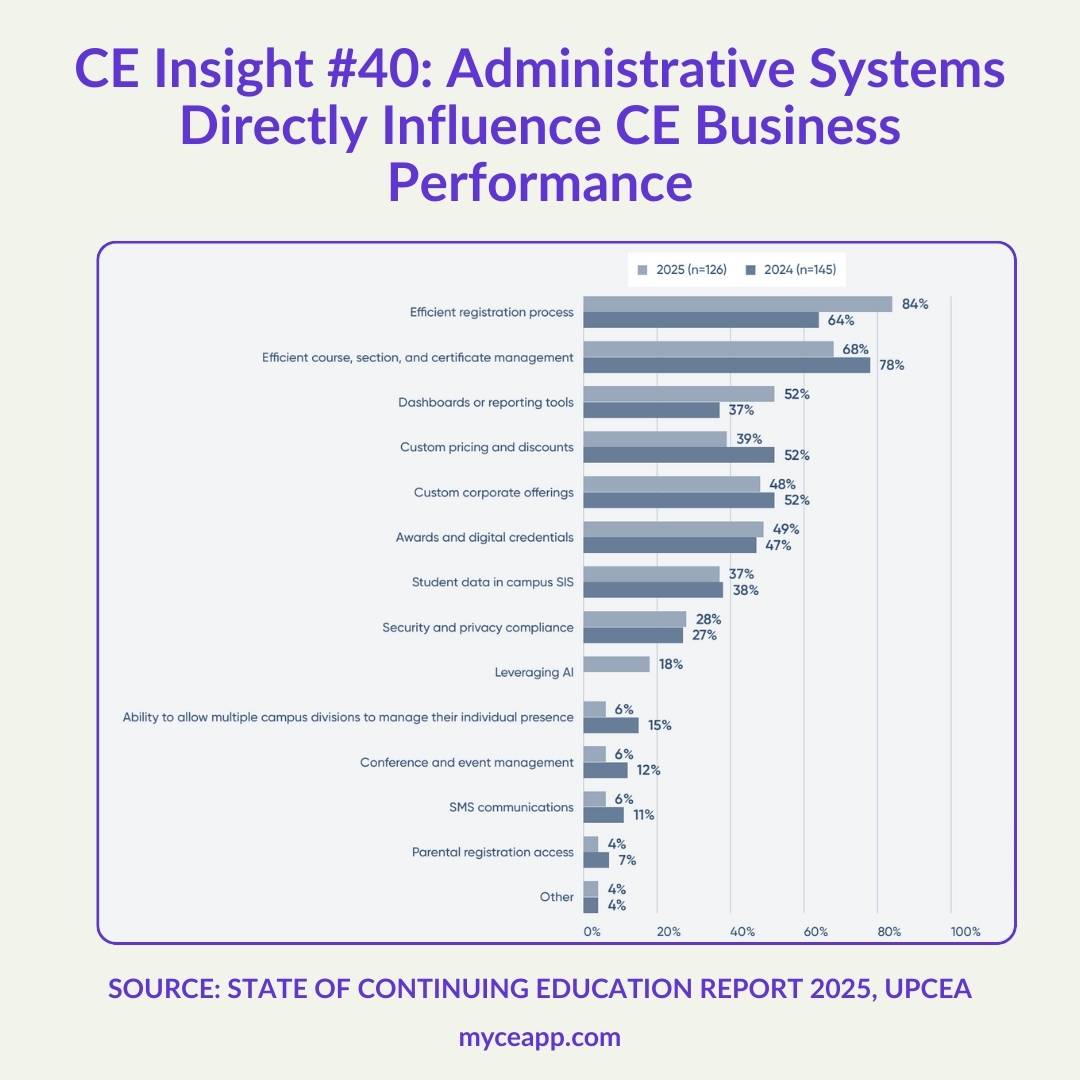
CE Insight #40: Administrative Systems Directly Influence CE Business Performance
84% of respondents say easy and efficient registration is essential for achieving business goals. Additionally, 68% cite efficient course and certificate management, 52% require dashboards/reporting, 48% need custom corporate offerings, and 39% need custom pricing capabilities. (Source: State of Continuing Education Report 2025, UPCEA)¹
Implications for Associations and Enterprises: Investment in user-friendly CE platforms like CE App, automation, and reporting systems is critical to improving learner experience and operational efficiency.
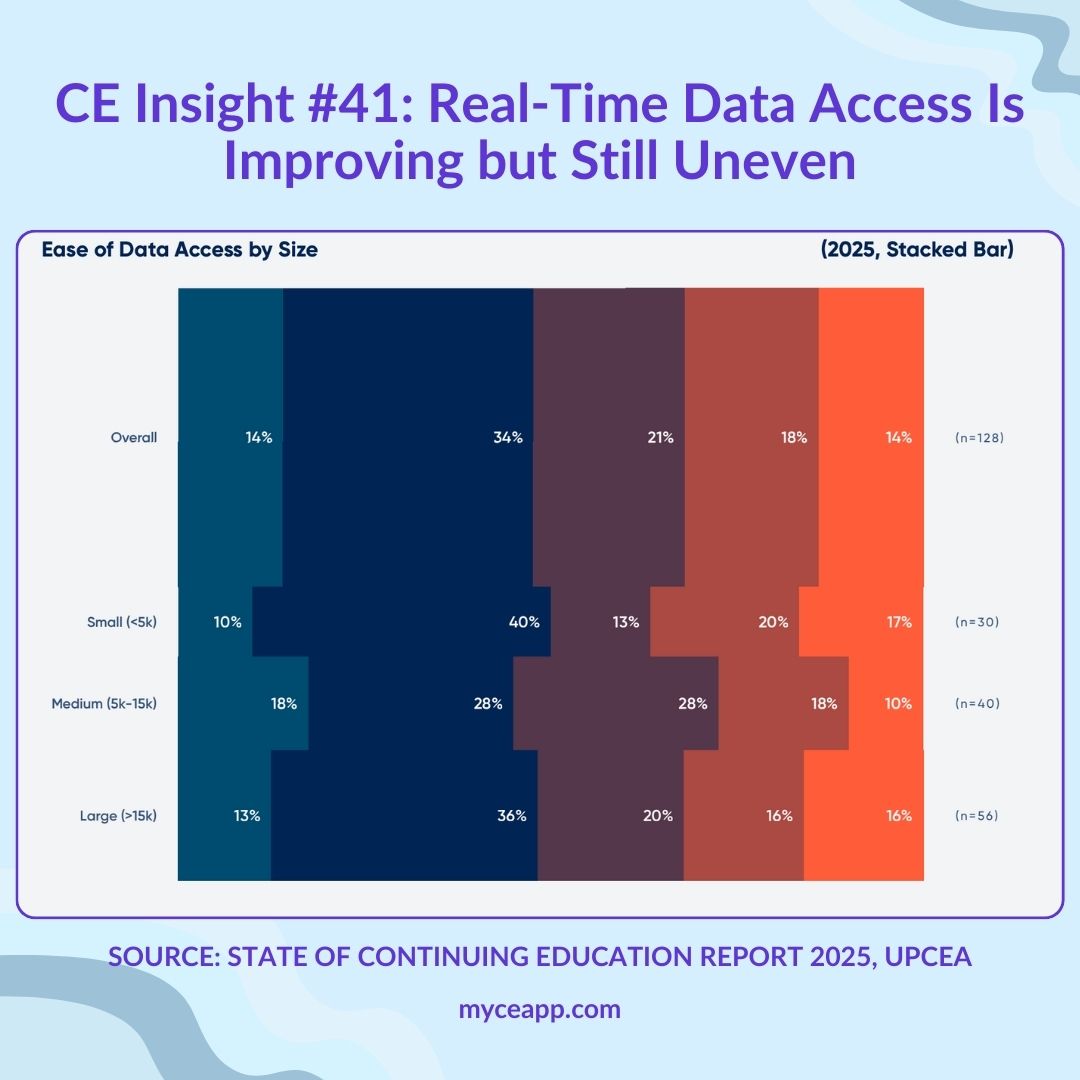
CE Insight #41: Real-Time Data Access Is Improving but Still Uneven
Access to real-time enrollment data increased to 48% of PCE units in 2025 (up from 29% in 2024). Smaller institutions report slightly higher access (50%) compared to medium ones (46%). (Source: State of Continuing Education Report 2025, UPCEA)¹
Implications for Associations and Enterprises: Timely decision-making requires stronger analytics capabilities, making real-time data visibility a priority for effective CE program management.
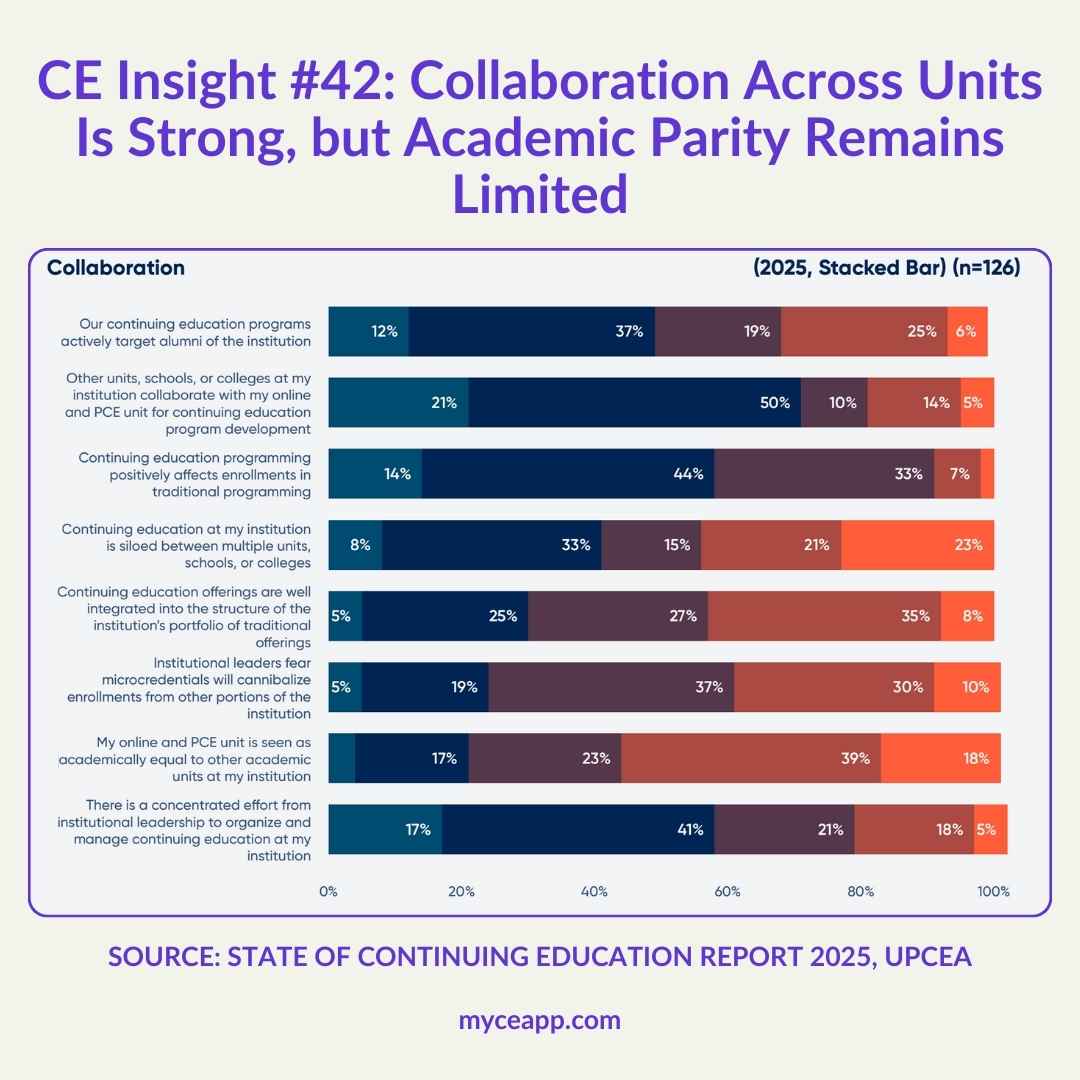
CE Insight #42: Collaboration Across Units Is Strong, but Academic Parity Remains Limited
71% of respondents say other campus units collaborate on CE program development, and 58% report a concentrated effortto expand CE. Despite this, only 21% feel their CE unit is considered academically equal to other university units. (Source: State of Continuing Education Report 2025, UPCEA)¹
Implications for Associations and Enterprises: Strengthening CE’s academic standing, improvinginternal alignment, and demonstrating program impact can help elevate CE’s institutional profile.
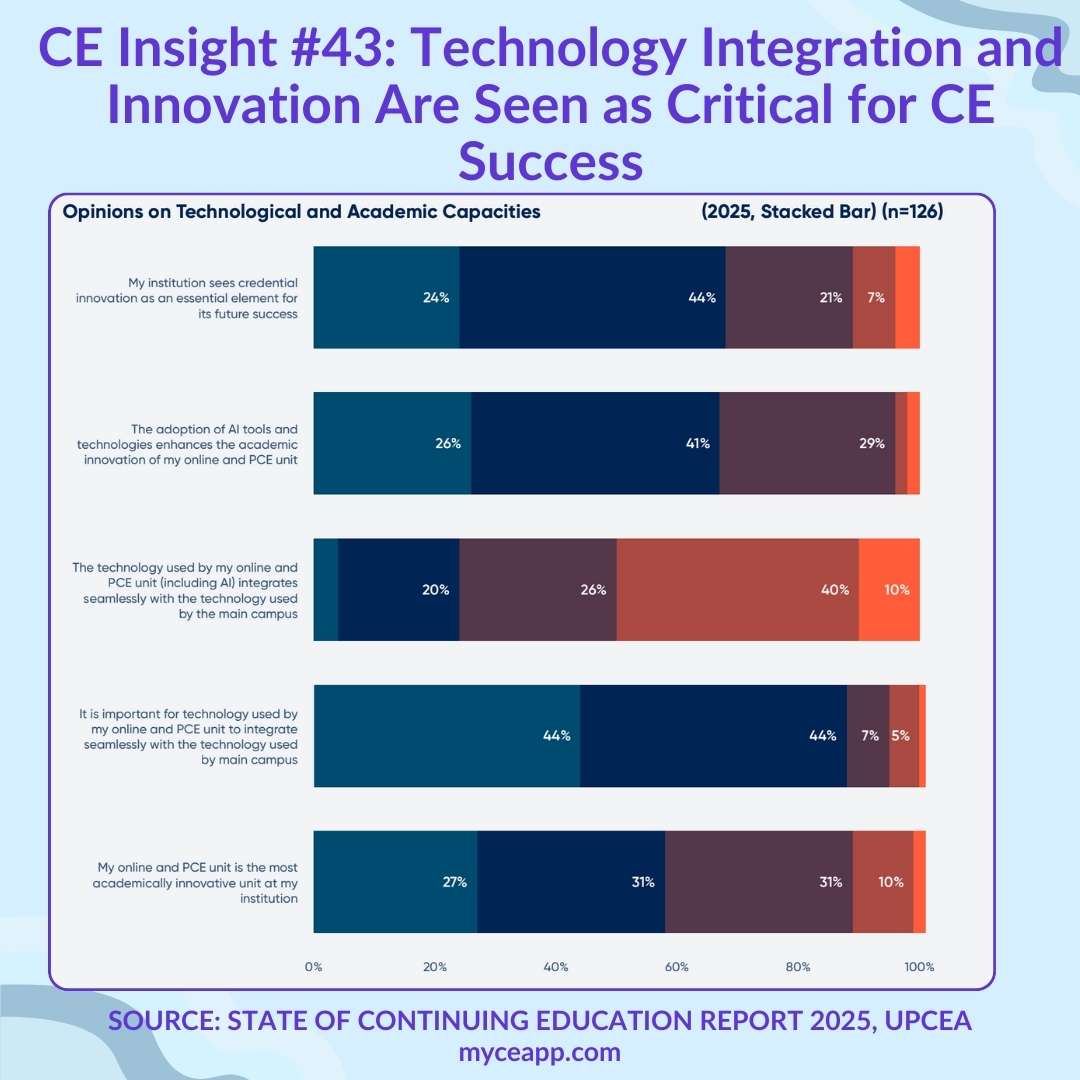
CE Insight #43: Technology Integration and Innovation Are Seen as Critical for CE Success
68% of respondents saycredential innovationisessential for future success, 67% believe AI adoption enhances academic innovation, and 88% say integrating CE systems with the main campus is vital. However, 50% disagree that such integration is actually happening, and only 17% feel their unit is viewed as academically equal. (Source: State of Continuing Education Report 2025, UPCEA)¹
Implications for Associations and Enterprises: Adopting AI, upgrading CE technology stacks, and improving system integrationare critical steps toward scaling innovation and ensuring program relevance.
CE Insight #44: Administrative Burden Continues To Slow Credential Expansion
CE units cite significant barriers to launching new credentials: 59% report administrative burden, 56% cite uncertain market demand, 40% cite labor-market relevance, 39% note time-to-market challenges, and 37% cite cost of launching new access points. (Source: State of Continuing Education Report 2025, UPCEA)¹
Implications for Associations and Enterprises:Reducingadministrative friction, improvingmarket validation, and acceleratinglaunch timelines will be essential for expanding credential portfolios.
Staffing and Operations Outlook For 2026
The 2025 data reveal a critical imbalance: while CE units enjoy strong leadership support and rising institutional expectations, they remain under-resourced, with gaps across finance, instructional design, technology, marketing, and program management. Operational strength increasingly depends on efficient systems, automation, real-time data, and integrated CE technology stacks that reduce administrative workload and improve learner experience.
Despite wide variation in revenue-distribution models, the institutions best positioned for 2026 will be those that align staffing,technology, and operational processes to support scalable, high-quality CE delivery.
2026 Actionables
Strengthenspecialized CE staffing in analytics, finance, instructional design, and technology.
Invest in automated registration, certificate management, and reporting systems.
Improvereal-time data visibility to support agile decision-making.
Advocateforacademic parity and stronger integration with core institutional systems.
Streamlineadministrative processes to enable faster credential development.
Labor Market and Employer Alignment
The shift to skills-based hiring is accelerating across industries, with employersincreasingly prioritizing verified competencies over traditional credentials or years of experience. This evolution is redefining how organizations evaluate talent, structure compensation, and invest in workforce development.
The statistics we cover in this final section of the post capture how CE programs can align with employer expectations and labor market dynamics in 2026.
CE Insight #45: Employers Strongly Prefer Hiring Candidates With Verified Micro-Credentials
97% of employers are already using or exploring skills-based hiring, 96% agree that micro-credentials strengthen a candidate’s application, and 87% have hired at least one micro-credential holder in the past year. (Source: Micro-Credentials Impact Report 2025, Coursera)²
[Note: This trend is also reflected in CE Insight #34 and CE Insight #51.]
Implications for Associations and Enterprises: With hiring shifting toward skills verification, CE providers must deliver transparent, competency-based credentials that clearly signal job readiness.
CE Insight #46: Employers Offer Salary Premiums for Candidates With Recognized Credentials
Across global and U.S. employers, 90% are willing to offer starting salaries 10–15% higher to candidates holding recognized or credit-bearing micro-credentials. (Source: Micro-Credentials Impact Report 2025, Coursera)²
Implications for Associations and Enterprises:Salary premiums create a strongvalue proposition for learners andreinforce the role of credentialed CE pathways in advancing career outcomes.
CE Insight #47: Employers See Micro-Credentials as Drivers of Productivity and Innovation
More than 50% of employers globally believe micro-credentials provide a competitive edge by improving productivity, innovation, and workplace readiness. (Source: Micro-Credentials Impact Report 2025, Coursera)²
Implications for Associations and Enterprises: CE providers can position micro-credentials as tools that strengthen organizational capability rather than just individual employability.
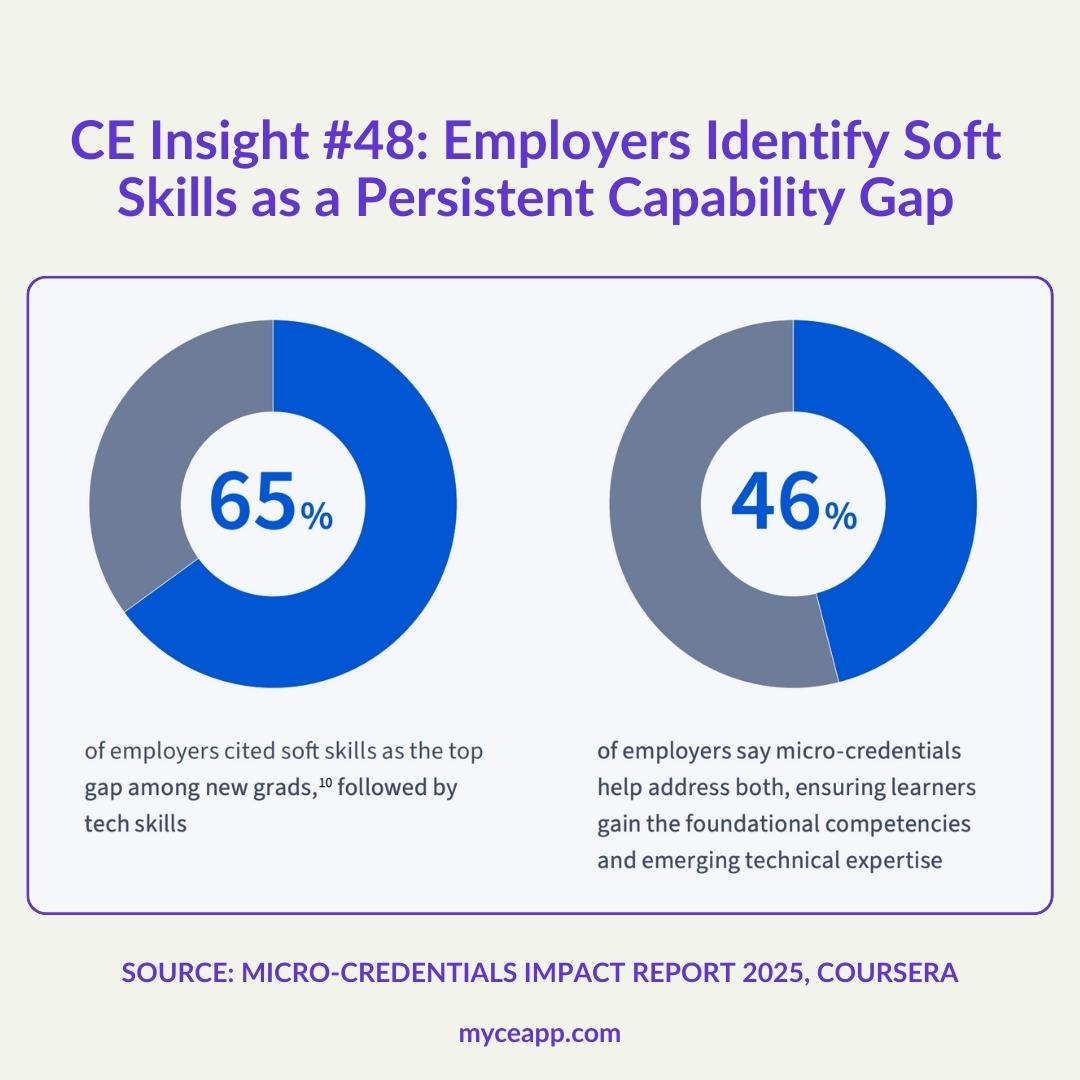
CE Insight #48: Employers Identify Soft Skills as a Persistent Capability Gap
70% of employers say recent graduates lackcommunication, resilience, and active listening skills. 65% cite soft skills as the top talent gap, ahead of technical skills. 46% say micro-credentials help address both. (Source: Micro-Credentials Impact Report 2025, Coursera)²
Implications for Associations and Enterprises: Soft-skill-aligned CE programming can fill a major capability deficit, supporting both workforce readiness and employability.
CE Insight #49: Micro-Credentials Deliver Measurable Career Advancement
Among entry-level employees holding micro-credentials, 80% reportimprovedday-to-day performance, 28%receivedapay increase, and 21%earnedapromotion. (Source: Micro-Credentials Impact Report 2025, Coursera)²
Implications for Associations and Enterprises:Clear career outcomes strengthen the appeal of stackable credentials, supporting both learner motivation and employer sponsorship.
CE Insight #50: Employers Actively Seek GenAI Talent but Face Supply Gaps
92% of employers say they would hirealess experienced candidate with a GenAI credential over a more experienced candidate without one, and 90% of U.S. employers show a similar preference. Meanwhile, only 17% of students have earned a GenAI credential, revealing a supply-demand imbalance. (Source: Micro-Credentials Impact Report 2025, Coursera)²
Implications for Associations and Enterprises:Offering GenAI-focused CE and credentials can directly address employer scarcity and position providers as leaders in future-critical skills.
CE Insight #51: Skills-First Talent Models Are Becoming the New Hiring Standard
97% of employers are already using or exploring skills-based hiring, and among those not yet using it, 93% plan to implement it. (Source: Micro-Credentials Impact Report 2025, Coursera)²
[Note: See also CE Insight #34 and CE Insight #45 for related employer adoption data.]
Implications for Associations and Enterprises: Skills-first hiring makes competency documentation, credential transparency, and skills mapping essential components of CE strategy.
CE Insight #52: Learners Use Micro-Credentials to Navigate Rapid Industry Change
71% of entry-level employees are concerned about rapid industry change, and 83% say micro-credentials increase their confidence to adapt. (Source: Micro-Credentials Impact Report 2025, Coursera)²
[Note: This data also appears in CE Insight #33, where it is contextualized within technology and automation trends.]
Implications for Associations and Enterprises: Programs designed around adaptability, continuous skill renewal, and future-readiness will resonate strongly with learners facing volatility.
CE Insight #53: Classroom CE Remains Large but Shifting Toward Hybrid and Online Models
The classroom learning segment accounts for over 41% of the U.S. CE market, though declines are expected as learners adopt hybrid and online modalities. Bootcamps continue to grow, with General Assembly’s Data Analytics Certification exceeding 97,000 graduates. (Source: U.S. Continuing Education Market Research Report 2025-2030, Research and Markets)3
Implications for Associations and Enterprises: Offering both in-person and online/hybrid learning modalities will meet diverse learner preferences.
CE Insight #54: AI and Machine Learning Courses Are Expanding Rapidly
Udemy’s Business Pro platform launched 1,000+ AI and machine-learning courses and partnered with the Society for Human Resource Management (SHRM) to offer HR recertification credits. (Source: U.S. Continuing Education Market Research Report 2025-2030, Research and Markets)3
Implications for Associations and Enterprises: Demand for AI/ML content presents opportunities for CE providers to expand their offerings or partner with established platforms to co-deliver content.
CE Insight #55: Demand for Long-Form, Deep-Skill CPE Hours Remains Strong
The Corporate Finance Institute (CFI) offers 254.5 hours of CPE credits across areas such as financial analysis, modeling, and strategy, demonstrating continued demand for long-form technical upskilling. (Source: U.S. Continuing Education Market Research Report 2025-2030, Research and Markets)3
Implications for Associations and Enterprises:Deep-skill CE formats remain essential for professions requiring advanced technical capability, making long-form CPE a continued growth area.
Labor Market and Employer Alignment Outlook For 2026
The 2025 data reflects a decisive shift toward skills-first hiring, verified competencies, and employer-recognized credentials. Employers increasingly reward credentialed talent with salary premiums, faster hiring, and career progression, while simultaneously reporting gaps in soft skills, GenAI capability, and future-critical technical skills. Micro-credentials now influence not only employability but also productivity, adaptability, and organizational performance.
As enterprises reshape their talent strategies around skills transparency, CE providers that deliver clear competency mapping, high-quality credential design, and employer-aligned programs will remain central to workforce development.
2026 Actionables
Align credential design with skills-based hiring frameworks used by employers.
Build or expand GenAI credential pathways to address employer scarcity.
Strengthen soft-skill development offerings to close persistent capability gaps.
Offer transparent competency documentation to support salary premiums and hiring decisions.
Partner with employers on co-branded upskilling and enterprise credential programs.
Add hybrid and online modalities to match shifting learner preferences.
Expand deep-skill CPE programs for regulated and technical professions.
Next Steps for 2026: What the 2025 Data Tells Us About the Road Ahead
The 55 insights in this report make one thing unmistakably clear. Continuing education is now a strategic driver of compliance, credentialing, workforce readiness, and talent development. Learners expect credit-bearing, stackable credentials, employers expect verified competencies, and regulators expect accurate, audit-ready documentation. CE providers are being asked to meet all of these expectations while navigating rapid change in technology, staffing, and learning delivery.
Across industries, the data shows a decisive shift toward modular learning, skills-first hiring, GenAI readiness, and outcomes-based education. CE leaders who want to stay ahead must move beyond incremental updates and adopt a modern approach that aligns credentialing, technology, and workforce strategy.
Organizations positioned for success in 2026 will:
Deliverflexible, workforce-aligned credentials that satisfy both licensing bodies and employer needs.
Adopt an AI-enabled and automated CE infrastructure to streamline compliance and reduce administrative bottlenecks.
Strengthendata visibility and reporting to support oversight, forecasting, and strategic planning.
Reducetime-to-market for new credentials by addressing administrative friction.
Designprograms that communicate clear, employer-recognized competencies.
These insights from 2025 reveal both the urgency and opportunity facing CE leaders. The organizations that modernize now will shape the future of credentialing, compliance, and workforce development.
Solutions like CE App can help associations & enterprises manage credit tracking, automate compliance reporting, and provide members with seamless access to their learning records, freeing up staff to focus on program quality and strategic partnerships.
Take Action Now
If the data in this report has made one thing clear, it is that CE teams benefit most when they move from insight to implementation. Whether you are refining your credential portfolio, improving learner experience, or updating your internal systems, you do not need to navigate these decisions alone.
If your organization wants to stay ahead of these shifts, now is the time to modernize your continuing education strategy.
Work with our CE specialists to review your current setup, discuss your goals for 2026, and identify the most effective steps you can take based on the trends highlighted across these 55 insights.
See howCE App works in real programs and explore practical ways to streamline credential management, consolidate records, and support learners through a unified CE experience.
The right tools and guidance can turn the insights from this report into clear next steps for your CE operations. Organizations that act on the data and modernize early will deliver stronger learner value, better employer alignment, and more resilient CE programs in 2026.
The US continuing education market was valued at $66.91 billion in 2024 and is projected to reach $95.98 billion by 2030, reflecting a 6.2% CAGR. This growth is driven by rising demand for micro-credentials, skills-based hiring, and flexible learning pathways.
Micro-credentials significantly boost engagement. Students are 2x more likely to remain engaged and 2.4x more likely to enroll when offered credit-bearing micro-credentials. Additionally, 94% of students want micro-credentials to count toward their degree.
97% of employers are already using or actively exploring skills-based hiring, a 20-point increase since 2023. Among those not yet using it, 93% plan to implement it, signaling a fundamental shift away from traditional credential and experience-based hiring.
Yes. 90% of employers globally are willing to offer starting salaries 10-15% higher to candidates holding recognized or credit-bearing micro-credentials. This salary premium applies consistently across North America, Europe, and the Asia Pacific regions.
CE units cite administrative burden (59%) as the top barrier, followed by market demand uncertainty (56%), labor-market relevance concerns (40%), time-to-market challenges (39%), and cost of launching new access points (37%). Streamlining operations is critical for credential expansion.
GenAI skills are increasingly essential. 86% of learners consider GenAI skills important, and 92% of employers say they would hire a less experienced candidate with a GenAI credential over a more experienced candidate without one. However, only 33% of entry-level employees currently receive GenAI training despite 69% wanting it.
Accredited CME programs increasingly measure real-world impact. In 2024, 95% measured learner competence, 46% evaluated clinician performance, 18% tracked patient health, and 8% assessed community or population health outcomes. This reflects a shift toward outcomes-based education.
94% of employers globally report that hiring candidates with micro-credentials reduces training time and cost. In the US specifically, 89% of employers confirm measurable cost savings, most commonly in the 10-20% range, making credentialed candidates a lower-cost talent pipeline.
Despite 79% of CE units having strong leadership support, only 35% feel they have adequate staff. Key gaps include finance and business analysts (27%), program managers (17%), marketing (14%), instructional design (13%), and technology and data roles (12%).
84% of CE leaders say efficient registration is essential for business goals. Investing in automated systems for registration, certificate management, and compliance reporting can significantly reduce administrative burden. Platforms like CE App help associations and enterprises streamline credit tracking, automate reporting, and provide learners with seamless access to their records.
CE units offer a diverse mix: 72% offer non-credit certificates, 55% offer digital badges, 35% offer credit-bearing certificates, 30% offer degrees, and 17% offer competency-based credentials. This variety reflects the need for flexible portfolios that meet different learner and employer requirements.
70% of employers say recent graduates lack communication, resilience, and active listening skills. 65% cite soft skills as the top talent gap, ahead of technical skills. Notably, 46% of employers say micro-credentials help address both soft and technical skill deficiencies.
Interprofessional CE (IPCE) is growing rapidly. Jointly accredited providers delivered 123,175 IPCE activities in 2024, up from 113,934 in 2023, representing 8.1% year-over-year growth. These activities reached nearly 34 million learner interactions, reflecting rising demand for team-based, cross-disciplinary learning.
Success in 2026 requires embracing modular learning, skills-first hiring alignment, GenAI readiness, and outcomes-based education. CE leaders should expand credit-bearing and stackable credentials, invest in automation and real-time data visibility, and reduce administrative friction. Solutions like CE App support this modernization by consolidating records, automating compliance, and freeing staff to focus on program quality.
According to the World Economic Forum, only 41% of workers will not require training by 2030. The remaining workforce breaks down as follows: 29% can be upskilled in their current roles, 19% can be upskilled and redeployed, and 11% are unlikely to receive training at all. CE providers must design programs addressing both upskilling and reskilling needs.